API in Trading: What It Is and How to Use It
Trading used to be a fairly closed process. You opened your broker's trading platform, studied the chart, clicked Buy or Sell, and manually managed the position from there.
APIs change that.
An API can allow your own trading software to communicate with a broker, exchange, market data provider, or another piece of trading infrastructure. Instead of sitting in front of a trading platform placing trades manually, you can build a system that receives real-time market data, analyzes it, checks your risk rules, places an order, and monitors the position automatically.
That is the basic idea behind API trading.
This guide covers what a trading API actually is, how API trading works step by step, the main API types and when each one makes sense, what you can realistically build, the risks that catch people out, and which API options are available to you at Switch Markets right now.
What Is an API in Trading?
API stands for application programming interface. In plain terms, an application programming interface (API) is a set of rules that lets two software programs communicate with each other without a human in between. Your weather app uses one. Your bank's mobile login uses one. In financial markets, a trading API does the same job for your brokerage account.
A trading API connects a trader's software to a broker's server. Your code sends a request in a format the broker's system understands. The server answers with data, a confirmation, or an error. This makes APIs a powerful tool for algo traders and anyone with basic technical skills who wants to automate trading, access market data, or build custom trading solutions.
The Four Jobs a Trading API Does
Almost everything an API does for a trader falls into four buckets.
- Market data: APIs provide real-time access to market data: live quotes, bid and ask, spread, and depth where the venue supplies it. Real-time pricing arrives as fast as your connection allows.
- Historical data: The same connection retrieves historical market data, which is the raw material for backtesting and for any model that needs to see how an instrument behaved over a given time period.
- Trade execution: Your code can place trades, modify them, and close them. API trading allows programmatic execution of trades based on conditions you define in advance.
- Account information: APIs monitor account balances, margin, equity, and open positions in real time, so your risk logic always knows what it's working with.
Four jobs, one connection. Market data access and trade execution are where most traders start, and once all four are running, you've replaced the platform window entirely.
A trading API connects your software directly to a broker, allowing you to access market and historical data, execute trades programmatically, and monitor account information without relying on a manual trading platform.
How Does API Trading Work?
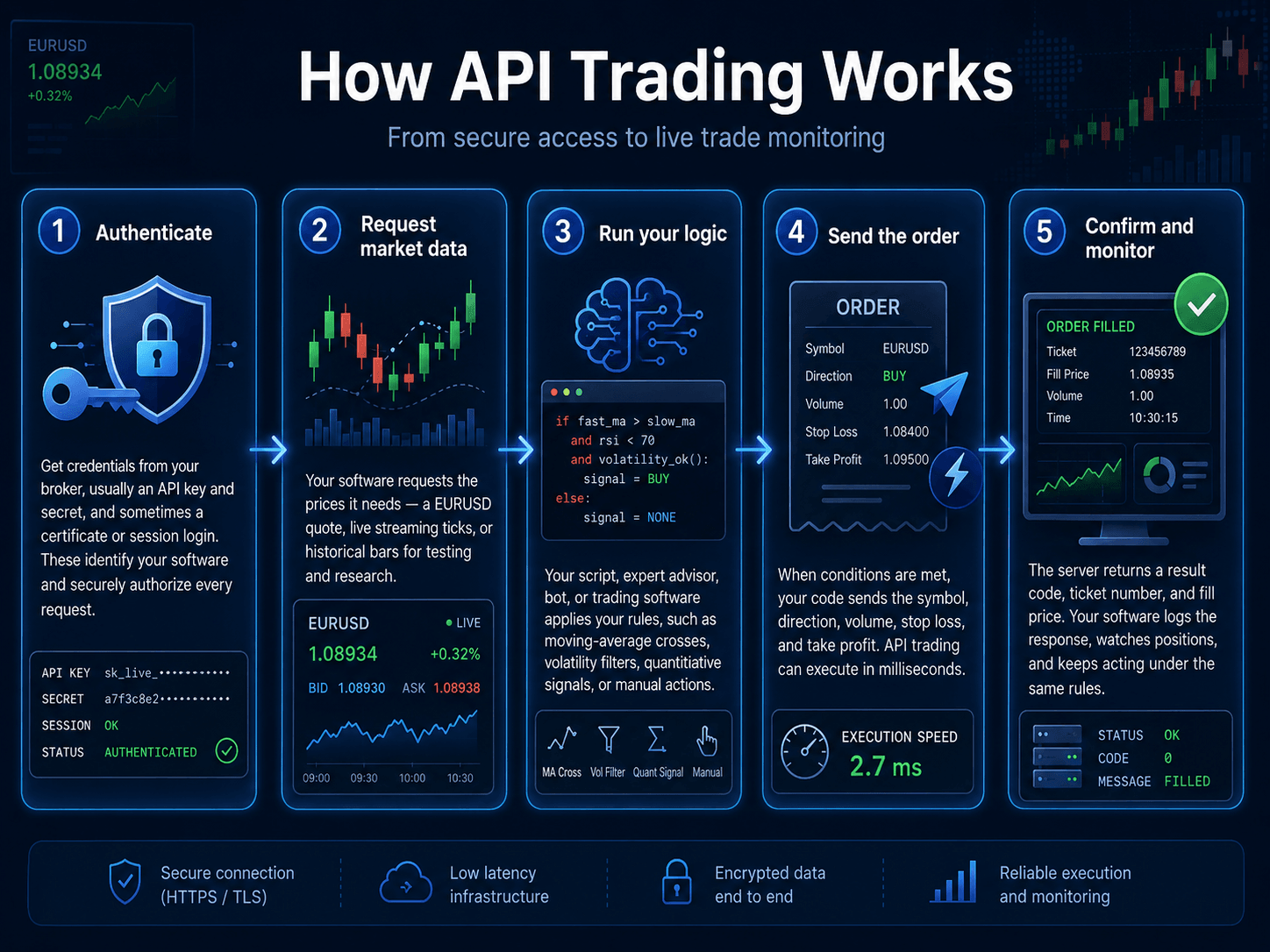
Here's the full loop, from credential to confirmation. Every trading system you'll ever build runs some version of these five steps.
- Authenticate: You get credentials from your broker, usually an API key and a secret, sometimes a certificate or a session login. The key identifies your software and grants secure access to your account. Every request you send after this carries it.
- Request market data: Your software asks for the prices it needs. That might be a single quote on EURUSD, streaming ticks across multiple instruments, or a year of daily bars for research.
- Run your logic: This part is yours. Your script, expert advisor, an automated trading bot, or other trading software applies whatever rules you've written: a moving-average cross, a volatility filter, a signal from quantitative models, or a manual button you press yourself.
- Send the order: When a condition is met, your code submits an order with the symbol, direction, volume, stop loss, and take profit attached. API trading can execute orders within milliseconds, which is the whole point for anyone trading breakouts, news, or fast-moving markets.
- Confirm and monitor: The server returns a result code, a ticket number, and a fill price. Your software checks it, logs it, and goes back to watching. It monitors positions continuously and acts on them under the same rules.
Then it loops. Forever, if you let it. Trading algorithms can run continuously to monitor markets 24/7, but to keep them running reliably without leaving your personal computer switched on, you’ll need a VPS (Virtual Private Server) to host the algorithm and maintain a stable connection to the broker. This is one of the biggest structural differences between API trading and placing trades manually.
That loop is the same everywhere. What changes between brokers and asset classes is the protocol the messages travel on, and that's where the API types come in.
The Main Types of Trading API
Three protocols dominate the market, plus a fourth practical route that most retail traders overlook. Which API type you need depends less on ambition than on what your strategy requires.
1. REST API
REST uses a request-response model, which means your software sends a request to an endpoint and receives a response. Unlike a WebSocket stream, the application typically has to make another request when it wants updated data.
This suits anything that doesn't need a continuous feed. REST APIs are often used for account information and submitting orders, pulling historical data, checking balances, and running end-of-day reporting. They're the easiest place to start because almost every programming language handles them out of the box, and you can test one from a browser before you write a line of real code.
The limitation is polling. If you want a live price with REST, you have to keep asking for it, which burns through rate limits and adds delay.
2. WebSocket API
WebSocket APIs solve exactly that problem. The connection opens once and stays open, and the server pushes updates to you as they happen. WebSocket APIs provide real-time data streams without repeated requests.
This is what you want for real-time market data: streaming quotes, order book updates, and instant fill notifications. APIs can stream real-time market data into analysis tools, dashboards, and charting software, and WebSocket is usually the pipe doing it.
Most modern trading systems run both. REST for the setup work and the orders, WebSocket for the feed.
3. FIX API
FIX (Financial Information eXchange) is the institutional standard. The FIX protocol enables ultra-fast order routing for institutions, and the same protocol carries orders across equities, futures, and FX around the world.
FIX APIs are used in high-frequency trading for low latency. The messages are compact, the sessions are persistent, and the execution speed is as close to the venue as a client can get. That performance comes with weight: FIX needs dedicated infrastructure, a session configuration agreed with the broker, and real programming knowledge to implement. Hedge funds and prop firms run FIX. A retail trader running one strategy on one pair almost never needs it.
4. Platform-Native APIs
If you already trade on MetaTrader, you already have an API, and you don't need to apply for anything to use it.
MetaTrader 5 ships with an official Python integration. Install the MetaTrader5 module, point it at your running terminal, and you get functions for account information, historical bars, live ticks, order submission, and position management, all from a Python script. MetaQuotes documents it publicly on the MQL5 site. It runs against the Windows Terminal, which pairs neatly with a Windows VPS.
MQL5 itself is the other half. An expert advisor is API trading by another name: your code, running inside the platform, reading data and sending orders. And MQL5's WebRequest function lets an EA call external REST APIs, so your strategy can pull in an economic calendar feed, a sentiment score, or your own signal service.
What You Can Build With a Trading API
Knowing the protocols is one thing. Knowing what to do with them is another. Here's where API access actually pays for itself.
Automated Strategy Execution
APIs enable automated trading strategies without manual input, and they execute trades on your rules whether you're at the desk, asleep, or on a flight. Automated trading can operate 24/7 without manual intervention, which matters most for anyone trading sessions that don't line up with their own waking hours.
Custom strategies can be implemented using APIs in whichever of the mainstream programming languages you're comfortable with, which is why Python, C#, and Java dominate retail algo work. And because you control the code, complex strategies stay possible: multi-timeframe filters, cross-instrument hedges, sizing that shifts with volatility. You're not limited to what a platform's strategy builder allows.
Automatic Risk Enforcement
APIs enable risk management by automatically enforcing trading rules that you'd otherwise have to enforce by willpower.
A daily loss cap that flattens everything and stops trading. A hard limit on open positions. Position sizing calculated from live equity on every single order, no exceptions. A rule that blocks new entries thirty minutes before a red-folder release. Written once, obeyed always.
Automation reduces emotional decision-making in trading, and this is where that benefit is most concrete. Code doesn't revenge trade.
Research and Backtesting
APIs can retrieve live quotes and historical market data, and the historical half is what makes serious research possible. Backtesting strategies with APIs helps optimize trading performance by showing how a rule set would have behaved across different market conditions before you risk anything on it.
One caution, and it's a big one: a backtest is not a demonstrated history of live performance. Past results, simulated or real, are not indicative of future results.
Custom Tools and Dashboards
APIs provide integration with various analytic tools and platforms, which means you can build your own tools instead of settling for what ships in the box. A live P&L dashboard. An exposure heat map across your whole book. A Google Sheet that updates itself. A Telegram alert when drawdown crosses a threshold.
You can also feed financial data into the analysis software you already use, whether that's Excel, a Jupyter notebook, or a full research stack.
Order Management at Scale
Order management systems use APIs to handle large order volumes: splitting a parent order into children, working it across venues, and tracking fills. Retail traders rarely need this. Anyone running a PAMM account, managing several accounts, or executing size across multiple instruments does.
API Trading vs Manual Trading
So what actually changes when you move from clicking to coding? What API trading offers comes down to four things.
- Speed: API trading allows orders to be placed in milliseconds. A human needs a second or two on a good day.
- Consistency: Your code applies the same rules to the ninth trade of a losing week as it did to the first. Most manual trading fails here rather than at the analysis stage.
- Coverage: One script can watch fifty symbols. You can watch about three.
- Availability: API trading enables continuous operation without manual input, across every session in global markets.
It’s important to realize that an API doesn't improve your strategy. Automating a losing system produces losses faster and more reliably than trading it by hand ever could. If your investment decisions are sound, the API amplifies them; if they aren't, it amplifies that too.
Manual trading also keeps one advantage worth naming: judgment about conditions your code has never seen. A liquidity vacuum on a bank holiday, a broken data feed, a headline that changes the regime. Most experienced algorithmic traders keep a hand on the kill switch for exactly that reason.
Who Actually Uses Trading APIs
At the institutional end, hedge funds, market makers, and prop desks run APIs as standard, with teams of quantitative analysts building and maintaining the models behind them. Execution speed is a measurable edge at that level, so FIX and colocation are ordinary infrastructure.
Below that sit professional traders and serious retail algorithmic traders: one person, one or two algorithmic strategies, running against a broker's API from a VPS. This group has grown enormously, mostly because the tooling got easier. You no longer need a computer science degree to automate a rule set.
And at the edge sits the active investor who wants to trade stocks, indices, and currencies from a single script, or who never writes a strategy at all and just wants their positions in a spreadsheet that refreshes itself. That's a completely legitimate use of API access, and it's where a lot of people start.
AI is also lowering the barrier to API trading even further. AI-powered coding assistants can help traders build, test, and modify API-based strategies without needing advanced programming skills, while AI models can process market data, generate signals, and automate parts of the decision-making process. This means APIs are increasingly becoming the bridge between AI tools and trading platforms, allowing traders to connect intelligent systems directly to their broker and turn ideas into automated workflows.
Hosting is changing along the same lines. Instead of setting up and patching a server themselves, some API traders now use managed runtimes such as TradingHost. You write a strategy with an AI coding assistant like Claude or Cursor and push it to GitHub. It then runs 24/7 in a container close to your broker's API, and AI agents can deploy and monitor it directly through the platform's native MCP server.
The Risks of API Trading
API trading adds a layer of software between you and your money, and software fails in ways clicking doesn't. Respect these before you connect anything to a live account.
- Misconfigured automation: The number one cause of API disasters. A decimal in the wrong place, a lot size read as 10 instead of 0.10, a loop that resends an order every tick. Misconfigured automation can lead to significant financial losses within seconds, and nobody's there to stop it.
- API key exposure: Your key is your account. API key exposure can result in unauthorized access to accounts, so never commit keys to a public repository, never paste them into a chat or a forum, and rotate them if you suspect a leak.
- Rate limits: Every broker caps how many requests you can send. Exceeding rate limits can lead to temporary or permanent bans, which means your system can be locked out mid-position.
- Latency: High latency can cause delayed orders and missed opportunities, and in fast-moving markets it turns a good fill into a bad one. Distance between your machine and the broker's server is the usual culprit.
- Breaking changes: API updates can break existing integrations and cause failures. A field gets renamed, an endpoint gets deprecated, and a system that ran for a year stops working on a Tuesday. Read the changelogs.
- Overfitting: A strategy tuned until it looks perfect on historical data usually falls apart live. The more parameters you optimize, the more likely you've modeled noise.
- Nobody watching: Automation removes you from the loop, which is the benefit and the danger in one. Build logging and alerting from day one.
API and Automated Trading Options With Switch Markets
This is where the subject becomes more interesting.
Switch Markets can support API and automated trading workflows, depending on the setup, account type, and connectivity requirements.
For instance, it can potentially accommodate FIX API access through a bridge and may also be able to support custom REST-style integration around MT5, depending on the client's requirements. These are not currently standard, plug-and-play products. Instead, API requests are considered on a case-by-case basis, with the exact technical setup, requirements, and available options needing to be checked with the Switch Markets Dealing team.
If you are a professional trader, algorithm developer, quantitative desk or algo business with a specific API use case, the best approach is to contact us and describe what you actually need: the markets involved, API type, expected order flow, market data requirements, execution requirements and desired integration. The team can then determine what is technically possible.
For traders who do not require direct FIX or REST connectivity, Switch Markets currently provides several easier routes into automated trading.
1. PineConnector
One of the most accessible options is PineConnector.
PineConnector is not a traditional broker REST or FIX API. It is better described as an execution bridge between TradingView and MetaTrader. TradingView generates an alert, PineConnector receives and authenticates the alert, and its MetaTrader Expert Advisor routes the instruction to your MetaTrader account. PineConnector describes typical alert-routing latency as under one second, excluding broker-side latency.
That makes it particularly useful for traders who already build trading strategies or indicators using Pine Script. Instead of waiting for a TradingView alert and then placing the trade manually on MT5, the alert can trigger automated execution.
Switch Markets currently provides eligible clients with complimentary PineConnector access. Its published terms require a verified live Standard or Pro account with at least $50 in equity, along with active trading and a request through Switch Markets support.
For someone whose primary goal is simply to automate a TradingView strategy, that may be considerably easier than building a complete trading API integration from scratch.
Learn How to Use PineConnector on Switch Markets
2. AlgoBuilder AI
Switch Markets also provides another option for traders who want automation without writing the entire system themselves: AlgoBuilder.
AlgoBuilder is designed to let users describe, build, backtest and deploy automated trading strategies with AI assistance. Switch Markets says the system builds Python-based strategies and deploys them into MetaTrader 5 through its Python Bridge.
That is an important distinction from direct API access.
The trader is still benefiting from programmatic trading and automated execution, but the integration layer is handled through the existing MT5 environment rather than requiring the trader to develop everything against a broker API manually.
Switch Markets currently states that full AlgoBuilder access is included for funded accounts.
For a trader primarily interested in getting an algorithm running rather than becoming an API developer, this may be the simpler option.
Learn How to Build a Trading Bot Without Coding on Switch Markets
3. VPS
A VPS is another important part of automated trading infrastructure, although a VPS itself is not an API. Any automated system needs to be online when you aren't. A laptop that sleeps, drops Wi-Fi, or installs updates overnight is not infrastructure.
So, a Virtual Private Server provides a remote computer that can keep your trading software running continuously.
This is where Switch Markets excels. Every Switch Markets client who opens a live account gets a free VPS worth $497, with room to host up to five algos. It runs on every operating system, which is what the MT5 Python module needs, and it sits close to our servers, where latency runs as low as 1ms. For anything running unattended, that combination matters more than most traders expect.
Learn Why a VPS is an Essential Tool for Traders
Wrapping Up
API trading is ultimately about giving software-controlled access to the trading process.
At the simplest level, an API might retrieve a few prices or some historical data. At the other end of the spectrum, APIs can sit at the center of institutional trading systems processing real-time market data, quantitative models, risk checks, order routing, and position management across multiple global markets.
The right setup depends entirely on what you are trying to accomplish.
REST APIs are well suited to many request-response tasks. WebSockets excel at streaming live information. FIX provides a standardized financial messaging framework for more sophisticated trading infrastructure. Platform integrations and bridges can meanwhile provide a much easier path for traders who want automation without building everything from scratch.
Switch Markets currently sits mainly in that latter category for retail traders, offering MT5 automation, PineConnector, AlgoBuilder and VPS infrastructure, while more specialized API connectivity such as FIX can potentially be considered on request.
Don’t start by asking which API is best. Start by deciding what you need your trading system to do. Once that is clear, choosing the right data access, automation and trade execution infrastructure becomes much easier.
FAQs
A few questions come up more than the rest. Here are our answers to them.
Do I need programming knowledge to use a trading API?
For a raw REST or FIX connection, yes. For everything else, not necessarily. PineConnector runs on TradingView alerts you set through a normal interface, and AlgoBuilder AI generates an expert advisor from a plain-English description.
Is API trading safe?
The connection itself is secure when you handle credentials properly: keep your API key out of your code, never share it, and rotate it if you suspect exposure. The larger risk is your own logic. A bug in position sizing or an unbounded order loop can do more damage in a minute than a bad trade does in a week. Test on a demo account, cap your risk in code, and keep a kill switch.
Can I use a trading API on a demo account?
Some MetaTrader-based automation can be tested on a demo account, including EAs and MT5 integrations. On Switch Markets, traders get a non-expiring demo account, so they can test strategies before applying them in live markets. However, eligibility for Switch Markets' complimentary PineConnector, VPS, and full AlgoBuilder access is tied to live/funded-account requirements. Any FIX or custom REST test environment should be confirmed with the team.
Risk Disclosure: The information provided in this article is not intended to give financial advice, recommend investments, guarantee profits, or shield you from losses. Our content is only for informational purposes and to help you understand the risks and complexity of these markets by providing objective analysis. Before trading, carefully consider your experience, financial goals, and risk tolerance. Trading involves significant potential for financial loss and isn't suitable for everyone.