Understanding Crude Oil Futures (CFDs) Spreads: Meaning, Example, and How to Trade
Crude oil is one of the most headline-sensitive markets on earth. One OPEC comment, one pipeline issue, one geopolitical scare, and the price can move $5 in minutes. If you’re trading flat price futures, you’re exposed to all of it.
Professional traders don’t play that game.
Instead of betting on where oil is going, they trade how oil is priced across time, geography, and refinement. They trade the structure of the market. They trade spreads.
Crude oil futures spreads allow you to strip out the noise, reduce directional risk, and focus on what actually moves the market: inventories, storage constraints, seasonality, and physical supply stress.
In this guide, you’ll learn exactly how crude oil futures spreads work, why contango and backwardation matter more than price direction, how professionals structure these trades, and how you can too.
What is a Crude Oil Futures Spread?
If you are trading crude oil by simply betting on whether the price will go up or down, you are exposing yourself to "flat price" risk. All that is required to wipe your account is just one single headline from OPEC or a geopolitical flare-up.
Professional traders and hedge funds operate differently.
They go beyond just trading the price; they trade the relationship between prices. This is the essence of a Crude Oil Futures Spread.
A spread trade is a single transaction that executes two opposing positions simultaneously:
- A Long position (Buying one contract).
- A Short position (Selling a different contract).
The goal is to predict whether the price gap (the differential) between those two contracts will widen or narrow.
For example, let's say you buy March Crude and sell April Crude. You are now "market neutral." If the entire oil market crashes by $10, your long position loses $10, but your short position makes $10. The flat price movement is irrelevant to you. You only care about the specific supply and demand mechanics that cause March to move differently than April.
This neutrality offers a massive advantage: Margin Offsets. Because the exchange recognizes that your short position hedges your long position, they require significantly less capital to hold the trade, often 80% to 90% less than an outright futures position.
So, you get the ability to leverage your capital without being at the mercy of the overall market direction.
Contango vs Backwardation in Crude Oil Markets
You cannot trade spreads effectively without understanding the shape of the futures curve.
The "curve" is simply a plot of futures prices over time, and its shape tells you everything you need to know about the physical reality of the oil market.
The curve only has two primary states: Contango and Backwardation.
What Is Contango?
Contango is the structure of a "normal" market. In this state, the futures curve slopes upward from left to right. This simply means that oil for delivery today is cheaper than oil for delivery six months from now.
Why does this happen? It comes down to the Cost of Carry. Oil is a physical commodity. It takes up space, requires insurance, and demands storage fees.
In a healthy market with ample supply, the future price must trade at a premium to the spot price to compensate the holder for storing that oil. If the spread covers the full cost of storage and interest, the market is in "Full Carry."
For spread traders, Contango signals an oversupplied market. When storage tanks are filling up, the "front month" (near-term contract) gets sold off aggressively relative to the "back months," causing the spread to widen.
What Is Backwardation?
Backwardation is the inverse. It is an "inverted" market structure where near-term prices are higher than long-term prices. The curve slopes downward.
While Contango is driven by storage costs, Backwardation is driven by the Convenience Yield. This occurs when there is a panic for immediate supply. Perhaps a pipeline has burst, war has broken out, or inventories are critically low.
In these moments, refineries don't care about storage costs; they are willing to pay a massive premium to get their hands on physical barrels right now. The utility of having the oil immediately outweighs the cost of holding it.
Backwardation is inherently Bullish. It screams that the market is tight and demand is stripping supply.
This is the "sweet spot" for bulls. If you are long the front month and short the back month in a backwardated market, you benefit from Positive Roll Yield.
As your front-month contract approaches expiration, it trades at a premium. You sell that expensive contract and buy the cheaper back-month contract, locking in a profit simply by rolling the trade forward.
This tailwind is why professional trend followers love backwardated markets.
Types of Crude Oil Spreads
When it comes to trading crude oil spreads, "one size fits all" does not apply. Traders select specific spreads based on the specific market inefficiency they want to exploit.
While there are dozens of exotic combinations, the vast majority of volume flows through three primary channels: Calendar Spreads, Inter-Market Spreads, and Product Spreads.
1. Calendar Spreads (Intra-Market Spreads)
This is the "bread and butter" of the futures market. A Calendar Spread involves buying and selling the same commodity (e.g., WTI Crude) but for different delivery months.
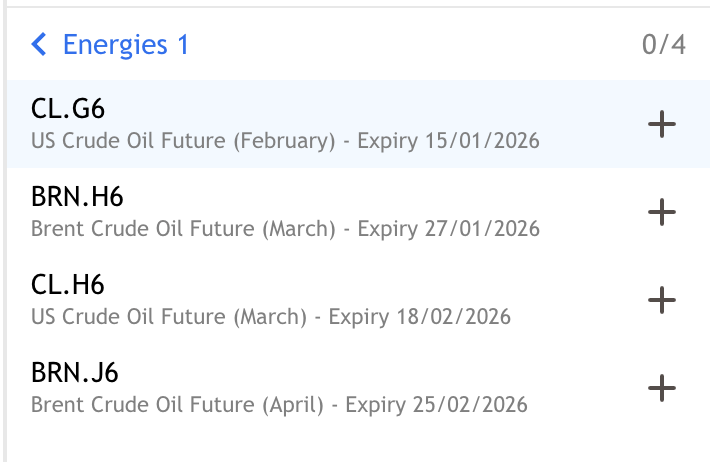
The image of the "Energies 1" watchlist on SwitchMarkets above is showing the individual contract months available for trading. To build a Calendar Spread, a trader identifies two of these specific expiration dates to pair against each other. This is possible on Switch Markets' platform, which makes it one of the few of the brokers in the industry allowing traders to trade crude oil futures spreads via CFDs (Contract for Difference).
For example, you can see CL.G6 (the February 2026 contract) and CL.H6 (the March 2026 contract). A spread trader might sell the CL.G6 and buy the CL.H6 to create a "Long March / Short February" spread position.
When you trade this, you are effectively trading the Term Structure of the curve. You are betting on how the market creates value over time.
For example, every trader knows that gasoline demand peaks in the summer driving season. A trader might buy June crude (to capture that summer demand) and sell December crude (when demand typically tapers off).
On the other hand, if storage hubs like Cushing, Oklahoma, are overflowing, the "front month" price will often collapse relative to deferred months because there is nowhere to put the oil today. A trader would Short the front month and Long the back month to profit from this storage crisis.
In trader parlance, we categorize these by intent:
- The Bull Spread: Long the Near Month / Short the Far Month. You execute this when you expect supplies to tighten. You want the market to move into Backwardation.
- The Bear Spread: Short the Near Month / Long the Far Month. You execute this when the market is oversupplied. You want the market to move into Contango.
2. Inter-Market Spreads
While calendar spreads look at time, inter-market spreads look at geography. The most famous trade in this category is the WTI vs. Brent Spread.
- WTI (West Texas Intermediate): This is US domestic, landlocked crude. Its price is heavily influenced by US shale production and pipeline capacity in the Midwest.
- Brent Crude: This is North Sea oil. It is "waterborne," meaning it can be shipped anywhere via tanker. It is the proxy for global geopolitical risk.
Normally, Brent trades at a premium to WTI (the "Brent Premium") due to transportation costs. However, this spread is volatile. If a war breaks out in the Middle East, Brent will spike faster than WTI because it is more exposed to global shipping lanes. If the US government bans oil exports (as it did prior to 2015), WTI will crash relative to Brent because the US oil is trapped domestically.
Traders watch this spread like hawks. If the spread widens to $6.00 when the historical average is $3.00, arbitrageurs will step in to bet on the spread reverting to the mean.
You can find more information about the Brent/WTI spread on the ICE exchange or the CME exchange.
3. The Crack Spread (Product Spread)
This is the most complex of the three, but it is the heartbeat of the physical economy. The Crack Spread represents the theoretical refining margin. This is the profit a refinery makes by "cracking" crude oil into usable products like gasoline and heating oil.
The industry standard is the 3:2:1 Crack Spread:
- Input: You buy 3 barrels of Crude Oil.
- Output: You sell 2 barrels of Gasoline and 1 barrel of Heating Oil (Distillates).
Who trades this?
- Refineries: They mainly use this spread to lock in their profit margins. If the price of crude rises but gasoline stays flat, their margin is crushed. They trade the spread to offset that risk.
- Speculators: They trade this as a proxy for economic health. If you believe the economy is booming and travel is surging, you buy the Crack Spread (betting gasoline prices will outperform crude prices).
Real Example of a Crude Oil Futures Spread Trade
Let’s dissect a trade setup that is currently on the radar of professional spread traders for 2026. This example illustrates how traders use the conflict between OPEC+ policy and seasonal demand to find value.
As we entered 2026, the WTI crude oil market was in a delicate balance. Prices had softened in late 2025 due to record U.S. production, but a major structural change occurred in January: OPEC+ delayed its planned production hikes.
Instead of flooding the market with oil in Q1, the cartel pushed the unwinding of their cuts to later in the year. Simultaneously, forecasts showed that while the market is well-supplied now, a deficit could form by June as the summer driving season kicks in.
A spread trader looks at this and sees a specific opportunity:
- Near Term (June 2026): Supply will be artificially tight because OPEC+ is withholding barrels during peak summer demand.
- Long Term (Dec 2026): Supply will likely normalize (or loosen) as non-OPEC production continues to grow and OPEC eventually unwinds cuts.
The trader wants to be Long the Summer and Short the Winter. This is a classic Calendar Bull Spread.
The Execution
- Leg 1 (Long): Buy June 2026 WTI (CLM26).
- Leg 2 (Short): Sell December 2026 WTI (CLZ26).
- Entry Timing: Early February 2026 (Anticipating the spring refinery ramp-up).
- The Spread Price: Let's assume the spread is trading near Parity ($0.00) or slightly in Contango (-$0.50).
Let’s explain why this works. You see, the trader is betting on Backwardation. They believe refiners will panic-buy June barrels to meet summer gasoline demand, driving the front-month price up. Meanwhile, the December contract will lag behind because the market expects the supply crunch to be solved by year-end.
If the "Summer Squeeze" thesis plays out and Cushing inventories tighten during the driving season:
- June 2026 (Front) rallies aggressively (e.g., +$5.00/bbl).
- Dec 2026 (Back) rises slowly or stays flat (e.g., +$1.00/bbl).
- The Result: The spread widens from $0.00 to +$4.00.
Profit Calculation
- Entry Spread: $0.00
- Exit Spread: +$4.00 (Backwardation)
- Net Move: +$4.00 per barrel.
- Total Profit: $4.00 x 1,000 barrels = $4,000 per contract.
As you can see, trading the spread will help you avoid the risk of a general market crash. Even if the entire oil market had dropped by $10 due to a recession, the spread likely would have held its value or increased as long as the physical tightness in June persisted relative to December.
Key Factors That Influence Crude Oil Futures Spreads
The price differential between two delivery months is driven by the structural reality of the oil supply chain.
If you want to trade spreads, you need to monitor these four critical drivers.
1. Inventory Levels
The single biggest driver of the WTI spread is the storage situation at Cushing, Oklahoma. This is the physical delivery point for the NYMEX WTI contract.
- The Saturation Point: When storage tanks at Cushing approach capacity (usually above 70% utilization), the market panics. There is literally nowhere to put the oil. Sellers become desperate to offload the "Front Month" contract to avoid taking physical delivery. This causes the front month to collapse while the back months (where storage might be available later) remain stable. The result? Market gets forced into Steep Contango.
- The Scarcity Point: Conversely, if inventories are draining rapidly (below 5-year averages), buyers bid up the front month to secure immediate barrels. The Result? The market snaps into Backwardation.
2. Seasonality
Oil demand is not linear; it is cyclical. Refineries are massive industrial complexes that cannot run forever. They must shut down for maintenance, typically during "shoulder seasons" when demand is lowest.
- Spring Maintenance (Feb/March): Refineries go offline to switch from winter heating oil production to summer gasoline production.
- Fall Maintenance (Sept/Oct): They go offline to switch back to winter blends.
During these windows, crude oil demand drops because the machines that process it are turned off. This temporary drop in demand often weakens the Front Month, causing spreads to widen (move toward Contango).
Conversely, ahead of the summer driving season (May-August), refineries run at full capacity, tightening the spread.
Learn More About Seasonality in Commodity Trading
3. Interest Rates
This is the factor most retail traders miss. Physical oil costs money to hold. I'm not only referring to storage fees, but in the Cost of Capital, as well.
When you store oil for six months, you are tying up cash that could otherwise be earning interest in a risk-free Treasury bill. When the Federal Reserve raises interest rates, the Cost of Carry increases.
- The Mechanic: If interest rates are 5%, the future price must trade at a higher premium to the spot price to compensate the holder for that tied-up capital.
- The Rule: High interest rates exert a widening pressure on the spread (encouraging Contango). Low interest rates make it "cheaper" to hold inventory, allowing spreads to tighten.
4. Geopolitics
Geopolitical events like wars, sanctions, or embargoes almost always impact immediate supply rather than future capacity.
If a conflict erupts in a major producing nation, the market fears a shortage today. Traders panic-buy the Front Month.
However, the market usually assumes the conflict will be resolved (or supply lines adjusted) within 6 to 12 months. Therefore, the Back Month prices rise much more slowly.
The Result: This disparity causes the spread to "blow out" into massive Backwardation.
How to Trade Crude Oil Futures Spreads (Step-by-Step)
Entering a spread trade is mechanically different from trading a flat price futures contract. If you try to execute this manually by buying one contract and selling another separately, you are exposing yourself to "Legging Risk,” which is the danger that the market moves against you in the split second between your two clicks.
Here is the professional workflow for executing a crude oil spread trade safely and effectively.
Step 1: Identify the Structure
Do not start by asking "Will oil go up?" Start by asking, "Is the market tight or loose?"
- Check the Curve: Pull up the Forward Curve for WTI or Brent. Is it sloping up (Contango) or down (Backwardation)?
- Check the Catalyst: Why is it shaped that way?
- Scenario A: Inventories are at 5-year lows, and a hurricane is entering the Gulf of Mexico. The market is tight. You want to be Long the Spread (Bull Spread).
- Scenario B: A recession is looming, and inventories are building. The market is loose. You want to be Short the Spread (Bear Spread).
Step 2: The Execution
This is the most critical technical step. Never "leg in" to a spread.
The major exchanges (CME, ICE) provide specific Exchange-Recognized Spreads. These are distinct instruments that represent the differential itself.
Here's the right way to go about the execution: You open your order ticket and select the "Calendar Spread" instrument (e.g., CL MAR26/APR26).
You enter a price of, say, -$0.50. When you click "Buy," the exchange's matching engine executes both legs simultaneously at that exact differential. You are never exposed to flat price risk for even a millisecond.
On the Switch Markets trading platform, you can search for Crude/Brent oil under the Energy tab. You will then find the two nearest contracts.
Step 3: Margin Management
One of the greatest advantages of spread trading is capital efficiency. Because your Long and Short positions offset each other, the exchange views your risk as significantly lower than a naked position.
They use a risk system called SPAN (Standard Portfolio Analysis of Risk) to calculate your margin.
- Outright Margin: Trading 1 contract of Crude Oil might require $6,000 in margin.
- Spread Margin: To trade the Spread (1 Long / 1 Short) might only require $500 to $1,000 in margin.
Step 4: Monitoring The Trades
Once you are in the trade, you are watching the differential price.
- If you bought the Bull Spread at -$0.50 (Backwardation), you want that number to move to +$0.50, +$1.00, etc.
The Exit Strategy: You have two choices as expiration approaches:
- Close: You sell the spread instrument. This closes out both legs simultaneously.
- Roll: If you want to keep your view but the contracts are expiring, you must "roll" the position. This involves selling your current spread and buying the next month's spread.
Wrapping Up
In sum, spread trading rewards traders who understand inventories, seasonality, storage constraints, and the shape of the futures curve. They punish those who trade opinions without context.
When you trade spreads correctly, you don’t need to predict where oil will be six months from now. You only need to understand where the pressure is today and how that pressure moves through time.
Master that, and crude oil stops being chaotic. It becomes mechanical. And that’s where consistent traders are made.
FAQs
Below, we address the most common practical questions traders have when moving from outright futures to the world of spreads.
What is the best crude oil spread to trade for beginners?
Start with the WTI Calendar Spread (Front Month vs. Second Month). For example, Long March / Short April. Why? It is the most liquid spread in the world. You will never get stuck in a trade because there is no volume. Note that you can start trading calendar spreads on Switch Markets.
Avoid complex Inter-market spreads (like WTI vs. Dubai) or Product spreads (Crack Spreads) until you have mastered the term structure of the curve.
Are crude oil futures spreads less risky than outright futures?
They are directionally less risky, but they are not risk-free. If you trade outright crude, you are exposed to every geopolitical headline. If you trade spreads, you are immune to the general price level, but you are exposed to structural changes (like a sudden change in inventory data).
How much margin is required for oil spreads?
Margins are set by the exchange (CME/ICE) using SPAN logic, which rewards hedged positions. While an outright Crude Oil contract (CL) might require $6,000+ in margin, a Calendar Spread often requires only $500 to $1,000. On Switch Markets, you can trade crude oil CFDs, which means the margin requirement is significantly lower than trading futures.
Can retail traders trade crude oil spreads?
Absolutely. You do not need to be a hedge fund. Any standard futures broker allows retail clients to trade futures spreads. Switch Markets is one of the few brokers offering traders the two front months of crude oil in the form of CFDs, which makes it accessible and easy for every retail trader to start trading crude oil spreads.
Risk Disclosure: The information provided in this article is not intended to give financial advice, recommend investments, guarantee profits, or shield you from losses. Our content is only for informational purposes and to help you understand the risks and complexity of these markets by providing objective analysis. Before trading, carefully consider your experience, financial goals, and risk tolerance. Trading involves significant potential for financial loss and isn't suitable for everyone.