Micro Lot Trading: What Is It and How Should You Use It as a Beginner or Advanced Trader?
- What Is Micro Lot Trading?
- How Does Micro Lot Trading Work?
- The Benefits of Using Micro Lots in Forex Trading
- Micro Lot Trading Examples
- How to Set Up Micro Lot Trading on MT4/5
- What to Look for in the Best Micro Account Brokers
- How Should You Use Micro Lots as a Beginner?
- How Should Advanced Traders Use Micro Lots?
- Wrapping Up
- FAQs
In forex and CFD trading, the term ‘lot size’ is one you’ll often encounter. But when people say micro lot trading, many beginners (and even some experienced traders) aren't entirely sure what that means or, more importantly, why it matters.
The short answer is this: they help beginners enter the live market with real money but without the pressure of oversized risk. And for advanced traders, they're useful for testing new strategies, scaling into positions, or simply "feeling the market" before committing to full-size trades.
On this page, we'll break down exactly what micro lot trading is, walk you through real examples, show you how to set it up on MT4 and MT5, and explain how to use it effectively.
What Is Micro Lot Trading?
A lot is the standard unit used to measure trade size in forex trading. Just like shares are used in the stock market, lots define how many units of the base currency you're buying or selling in a currency pair.
There are four main lot sizes in forex, from the largest lot size to the smallest lot size:
- Standard Lot: 100,000 units of the base currency (1.0 lots)
- Mini Lot: 10,000 units of the base currency (0.1 lots). This is one-tenth of a standard lot
- Micro Lot: 1,000 units of the base currency (0.01 lots). This is one hundredth of a standard lot
- Nano Lot: 100 units of the base currency (0.001 lots). This is the smallest contract size available
A micro lot, therefore, represents 1,000 units of the base currency. It's expressed as 0.01 lot size on MT4 and MT5. Because one micro lot is one hundredth of a standard lot and one tenth of a mini lot, it gives retail traders and new traders the most accessible entry point into live forex trading.
For example, if you're trading EUR/USD, one micro lot means you're controlling 1,000 euros. At an exchange rate of 1.0850, that's a position worth $1,085, versus $108,500 on a standard lot.
Did you get the memo now? The micro lot size lets you participate in the forex market without needing large capital.
Here's how the lot sizes compare, from largest to smallest:
The highlighted row is the sweet spot for most retail traders starting out, and it's precisely what Switch Markets makes available to you on both MT4 and MT5.
Learn More About Lot Size in Trading
How Does Micro Lot Trading Work?
We’ve said earlier that when you open a micro lot trade, you're entering a position in 1,000 units of the base currency. The key thing to understand is what this means for your pip value and overall risk exposure.
For most USD-quoted forex pairs like EUR/USD, GBP/USD, or AUD/USD, each pip movement in one micro lot is worth approximately $0.10. That means:
- A 10-pip move in your favour = +$1.00 profit
- A 10-pip move against you = -$1.00 loss
- A 50-pip move in your favour = +$5.00 profit
- A 100-pip stop loss = -$10.00 maximum loss
These small numbers might not sound exciting, but they're manageable, and that’s the whole point of micro trading.
With forex micro lots, you can hold positions with proper stop losses and realistic take profit targets without putting significantly smaller capital at risk on any single trade.
The Benefits of Using Micro Lots in Forex Trading
Here's why forex brokers widely recommend micro accounts to anyone who wants to start small:
1. Lower Risk Exposure
This is the most obvious advantage. Because you're trading 1,000 units instead of 100,000, your risk exposure per trade is proportionally smaller. A 50-pip loss on a standard lot costs you $500. On one micro lot, that same 50-pip loss costs just $5.00.
Truth is, the market doesn't care how big your position is. So why not learn and test at small capital risk?
2. Better, More Precise Risk Management
Good traders think about trade size as a percentage of their account. The general rule is to risk no more than 1–2% of your account per trade. That's where risk management and position sizing with micro lots becomes essential.
Let's say you have a $500 account and you're willing to risk 2% ($10) on a trade with a 50-pip stop loss. With standard accounts and mini lots, it's nearly impossible to calibrate this precisely. However, with micro lots, you can trade exactly 2 micro lots (0.02 lot) and your 50-pip stop comes out to exactly $10.
The good thing is, you don’t need to manually do the calculation to get your lot sizes; you can just use Switch Markets' free Lot Size Calculator to find the exact position size for any trade, based on your account balance, currency pair, and stop loss distance.
3. Real-Money Trading Without Real-Money Pressure
There's a massive psychological gap between demo trading and live markets. On a demo account, it's easy to follow your rules because there's no real money on the line. The moment real money enters the picture, emotions kick in.
Micro trading bridges this gap perfectly.
You're trading real money, but the amounts at stake are small enough that the psychological pressure doesn't overwhelm your decision-making.
4. Practice Strategies in Live Market Conditions
Demo accounts don't replicate everything. Execution, price slippage, and the psychological component of real losses all differ from demo to live.
Micro (Cent) accounts let you practice strategies in live trading conditions with real fills, real spreads, and real market behaviour.
Micro Lot Trading Examples
Numbers help. Let's walk through a few real-world scenarios to show exactly how forex micro lots work in practice.
Example 1: The Beginner with a $300 Account
Sarah is new to forex trading. She's been demo trading for a month and feels ready to try a live account. She deposits $300 and wants to risk no more than 2% per trade ($6.00).
She spots a setup on GBP/USD with a 30-pip stop loss. Using the Lot Size Calculator, she finds that 2 micro lots (0.02) gives her a risk of $6.00 on a 30-pip stop.
She places the trade, follows her rules, and (whether it wins or loses) she's stayed disciplined and within her plan. This is how micro lots make risk management achievable from day one, even with small capital.
Example 2: The Advanced Trader Testing a New EA
Marcus is an experienced trader who has built a new Expert Advisor on MT5. Before running it at full size, he wants to test it in live markets to check for execution issues and unexpected behaviours under real trading conditions.
He runs the EA on a live account using a 0.01 lot size (one micro lot) per trade. Over 30 trades, the EA performs consistently with the backtest. With confidence established, Marcus scales up to his intended position size. Micro lot trading just saved him from discovering a critical bug at full capital risk.
How to Set Up Micro Lot Trading on MT4/5
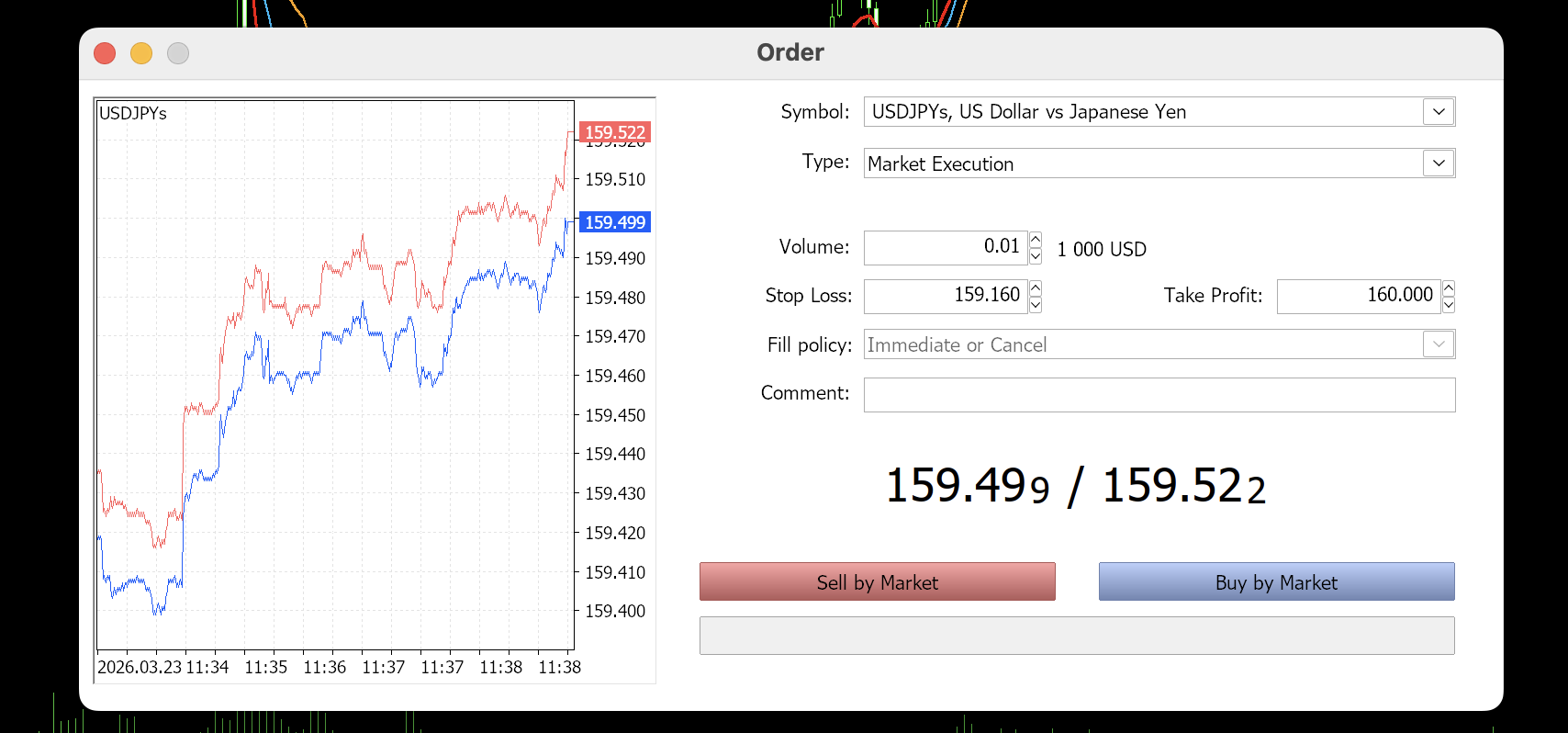
Setting up micro lot trading on MetaTrader 4/5 is straightforward. Here's how many units you control at each step, and how to place your order:
- Open MT4/5 and log in to your Switch Markets account.
- In the Market Watch window, right-click the forex pair you want to trade and select "New Order."
- In the "Volume" field, type 0.01 for one micro lot. For multiple micro lots, type the appropriate decimal (e.g., 0.05 for five micro lots).
- Set your Stop Loss and Take Profit levels to manage risk carefully.
- Click "Buy" or "Sell" to execute the trade.
What to Look for in the Best Micro Account Brokers
Not all forex brokers offer the same trading conditions for micro trading. When evaluating the best micro account brokers, look for these key factors:
- Minimum deposit: The best micro accounts allow you to start small. Ideally, with a low minimum deposit so beginners can access live markets without committing large sums.
- Tight spreads: Even on one micro lot, tight spreads matter. Wider spreads eat into your potential profits faster on smaller positions. Look for forex brokers like Switch Markets that offer micro lots with spreads from 0.0 pips on major forex pairs.
- Leverage: With micro lot trading, leverage is useful for small capital accounts, as long as you manage risk carefully.
- Platform: MT4 and MT5 are the industry standard. Check that your broker supports both and allows micro lot sizing (0.01 lots) natively.
- Risk-averse options: Good forex brokers for risk-averse traders will also offer stop-loss protection tools, negative balance protection, and educational resources.
Switch Markets supports micro lot trading on both MT4 and MT5 with tight spreads from 0.0 pips, 0% commission on standard accounts, and leverage up to 500:1, making it one of the most accessible platforms for both beginner traders and experienced traders who want to start small.
How Should You Use Micro Lots as a Beginner?
If you're new to forex trading, micro lots are your best friend. Here's how to use them intelligently from the start:
Start with a Demo Account, Then Move to Micro Lots
Before you risk any real money, use Switch Markets' non-expiring demo account to get comfortable with the platform, practice strategies, and get familiar with live markets in a risk-free environment.
Once you feel confident, the transition to micro lot live trading is the logical next step.
Follow the 1–2% Risk Rule
Never risk more than 1–2% of your account on any single trade. Micro lots make this achievable even on smaller accounts.
If you have a $200 account, your max risk per trade is $2–$4. That might mean trading 1–2 micro lots with a 20-pip stop, for example.
Use the Lot Size Calculator to always know your exact risk exposure before entering.
Focus on Learning, Not Earning
At this stage, your goal isn't to generate income. Rather, it's to build consistency.
Micro lot trading lets you trade with real stakes (which creates real discipline) without the financial pressure of losing large amounts while you're still learning. Think of it as paying a small fee for a live education. Start small, stay disciplined, and use every trade to fine-tune your trading strategy.
Keep a Trading Journal
Every micro lot trade you take is a data point. Journal your setups, your entry rationale, the outcome, and what you learned.
Over time, patterns will emerge. This habit alone puts you ahead of the vast majority of retail traders. Switch Markets provides a free trading journal template to help you get started.
Download Our Free Trading Journal
How Should Advanced Traders Use Micro Lots?
Micro lots aren't just for beginners. Experienced traders regularly use them as a strategic tool. Here are the key use cases:
Validating New Strategies in Live Market Conditions
Backtesting a trading strategy on historical data is a good start, but it doesn't account for live execution, spreads, or the psychological impact of real losses.
Before scaling any new strategy to your normal lot size, run it for 20–30 live trades at 0.01 lot under real trading conditions. If the results align with your backtest, you have genuine confidence to scale up.
Testing New Expert Advisors (EAs)
Any automated strategy needs live validation before full deployment. Micro lot trading is the ideal vehicle for this. Deploy your EA at 0.01 lot and monitor it across different market conditions.
Switch Markets' ecosystem (including the free VPS, PineConnector, and AlgoBuilder) makes this process seamless.
"Feeling the Market" Before Full-Size Entry
Even experienced traders sometimes encounter setups that look great on paper but feel uncertain. In these situations, entering a micro lot position first allows you to observe the market's reaction in real time without meaningful risk exposure.
If the trade confirms your trade plan, you add to the position. If not, you exit with a minimal loss.
Recovering from Drawdowns with Controlled Position Sizing
After a losing streak, it can be tempting to overtrade or increase size to "make it back." This feeling, known as Trading on Tilt, is one of the most dangerous impulses in trading.
Instead, experienced traders often temporarily reduce their position sizing to micro lots while they focus on rebuilding confidence and re-establishing their edge. It's a controlled, professional response to adversity.
Wrapping Up
In sum, micro lot trading lowers the barrier to entry, forces better risk management, and gives you real market experience without the pressure of outsized risk exposure.
The best traders don't measure their success by how big their positions are. They measure it by how consistently they execute their trading strategy. Micro lot trading gives you the platform to develop that consistency and keep it, even as you grow.
FAQs
Still have questions about micro lot trading on Switch Markets? Here are answers to some of the most common ones.
What is the minimum lot size on Switch Markets?
Switch Markets supports a minimum deposit and a smallest lot size of 0.01 (one micro lot) on both MT4 and MT5. This smallest contract size applies to most forex pairs and CFD instruments available on the platform.
Is micro lot trading suitable for small accounts?
Yes. Micro accounts are ideal for smaller accounts precisely because they allow proper risk management at lower capital levels. A $100–$500 account can apply a 1–2% risk rule, meaningfully using micro lot trading. This is why brokers that offer micro lots are so popular with beginner traders and risk-averse investors.
Can I use micro lots to trade instruments other than forex?
On Switch Markets' MT4 and MT5 platforms, micro lot trading is available across forex pairs, indices, gold, silver, oil, and digital currencies. Always check the contract specification for the lot size and pip value of each specific instrument before you start trading.
Risk Disclosure: The information provided in this article is not intended to give financial advice, recommend investments, guarantee profits, or shield you from losses. Our content is only for informational purposes and to help you understand the risks and complexity of these markets by providing objective analysis. Before trading, carefully consider your experience, financial goals, and risk tolerance. Trading involves significant potential for financial loss and isn't suitable for everyone.