How to Trade Platinum: A Complete Guide to Platinum Trading
Platinum just handed traders a masterclass in volatility. The metal more than doubled in 2025, spiked to a record above $2,800 per ounce in January 2026, then surrendered roughly 40% of its value in under six months. Traders who understood the market caught a generational move. Traders who treated platinum like gold got punished.
Platinum doesn’t behave like other precious metals because it isn’t purely a precious metal. It’s a hybrid: part safe-haven asset, part industrial workhorse. That split personality gives it sharper swings, thinner liquidity, and bigger opportunities than gold or silver.
This guide covers where platinum’s demand actually comes from, what moves the price, how to trade it, and the risks that come with each.
What Is Platinum?
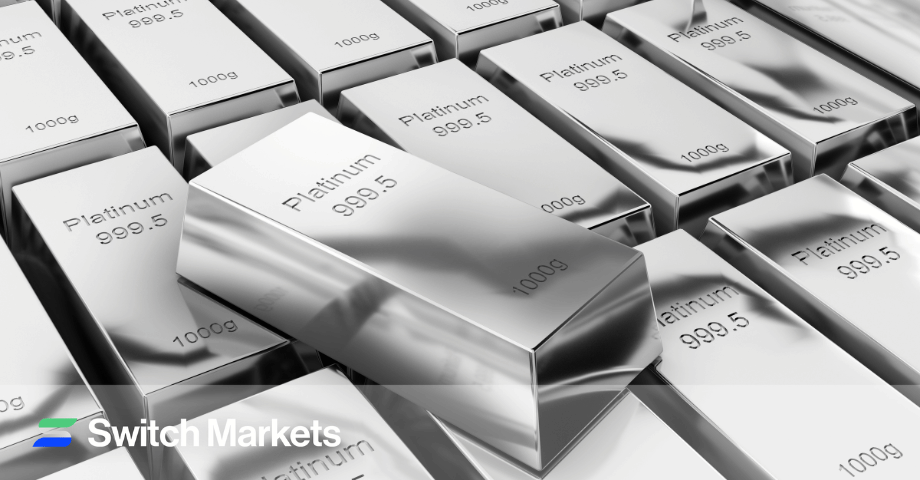
Platinum is the rarest of the major precious metals. Every ounce ever mined would fit inside an average living room, and miners dig up about 20 ounces of platinum for every one ounce of gold, year in and year out. Scarcity, though, is only half the story.
What sets platinum apart is its dual function. It’s a precious metal, prized for rarity and traded alongside gold and silver. It’s also an industrial metal, consumed by factories in everything from catalytic converters to lab equipment. When fear rises, investors buy it as a store of value; when the economy expands, industrial users buy it as a raw material. Few commodities pull demand from both directions at once.
The metal’s trading history is shorter than gold’s but richer than most traders realize:
- 18th century: European scientists first document platinum after Spanish explorers encounter it in South America. The Spanish call it platina, ‘little silver.’
- 1828–1845: Imperial Russia circulates platinum roubles. Across its imperial, Soviet, and modern eras, Russia has minted more than 500,000 ounces of platinum coins.
- 1956: The New York Mercantile Exchange (NYMEX) introduces platinum futures, the metal’s first standardized, exchange-traded contract.
- 1975: Tanaka Kikinzoku Kogyo mints the first platinum bullion bars aimed at individual investors in Japan and opens the physical market to ordinary buyers.
- 1997: The US Mint launches the Platinum American Eagle, still the world’s most popular platinum coin.
Today platinum trades under the ticker XPT. Spot prices are set in London’s over-the-counter market, where the London Platinum and Palladium Market runs twice-daily auctions that serve as the global benchmark. Futures trade on NYMEX, part of CME Group. Platinum itself doesn’t list on any stock exchange; you reach it through the instruments covered later in this guide.
What Is Platinum Used For?
Ask most people what platinum is for, and they’ll say jewelry. The real answer is far bigger: by one industry estimate, nearly 20% of all manufactured goods either contain platinum or depend on it during production. Knowing where demand comes from tells you where prices are likely headed.
Catalytic Converters and the Automotive Industry
The automotive sector is platinum’s anchor. About 40% of annual platinum demand goes into catalytic converters, the devices that strip carbon monoxide, nitrogen oxides, and unburnt hydrocarbons from vehicle exhaust; in strong production years that’s close to half of end-use consumption.
Diesel vehicles rely on platinum most heavily, which is why European emissions policy moves the metal so sharply. Petrol engines historically favored palladium, but after years of palladium scarcity, automakers have substituted platinum into petrol catalysts too, which gives the metal another source of fresh demand.
Tighter emissions rules keep platinum loadings high even as electric vehicles chip away at combustion-engine volumes. The full transition matters for the 2030s; for now, hybrids, which still need catalytic converters, are growing faster than pure EVs in many markets.
Jewelry
Platinum’s purity, density, and resistance to tarnish make it the premium choice for wedding and engagement rings.
The jewelry industries of China, Japan, India, and the US absorb about a quarter of supply in a typical year, and this consumer demand is price-sensitive: buying strengthens when platinum looks cheap next to gold and softens after sharp rallies.
Industrial Applications
Beyond cars and jewelry, platinum earns its keep in less visible places:
- Chemicals and refining: catalysts for fertilizer production and petroleum refining
- Glass: crucibles and bushings for fiberglass and display glass, where the metal withstands extreme heat
- Electronics and data: hard-disk coatings, sensors, and optical components inside AI data centers
- Medical devices: pacemaker electrodes, stents, and implants, plus platinum compounds used in chemotherapy drugs
- Laboratory equipment: crucibles, electrodes, and thermocouples that have to resist corrosion
- Hydrogen: fuel cells and electrolyzers, a small demand base today but the fastest-growing piece
Investment
Finally, investors hold platinum as bars, coins, and exchange-traded funds. Bullion bars typically carry a purity of 99.95%, the same standard the American Eagle uses.
Investment flows are the swing factor in platinum markets: they can add or subtract hundreds of thousands of ounces in a single year, which is exactly what happened between 2025 and 2026.
Platinum’s Global Supply and Demand 2026
Platinum’s story in 2026 is a market running down its savings.
Supply
South Africa produces nearly 70% of the world’s mined platinum; Russia, Zimbabwe, and North America supply most of the rest.
That concentration is platinum’s defining risk. Strikes, electricity shortages, and political instability in producing regions can tighten supply overnight.
Years of low prices before 2025 also starved the industry of investment, so higher prices can’t summon new ounces quickly; a new mine takes about a decade to build.
The World Platinum Investment Council (WPIC) expects mine supply of roughly 5.5 million ounces in 2026, essentially flat. Recycling should climb about 9% as higher prices coax spent catalytic converters and old jewelry back into the market. Total supply still falls short of demand.
Demand
Total platinum demand is forecast to fall 9% to about 7.67 million ounces in 2026, but the headline hides a rotation.
Industrial demand is set to grow 9% with the broader economy. Automotive slips a modest 2% to around 2.9 million ounces, and jewelry falls 12% after 2025’s price spike.
After heavy ETF and exchange-stock inflows during the rally, WPIC expects net outflows in 2026, even as bar and coin buying jumps 27% to 718,000 ounces.
The Deficit
Put supply and demand together, and the platinum market records its fourth straight annual deficit in 2026.
WPIC pegs the shortfall at 297,000 ounces, on the heels of a deficit above one million ounces in 2025. Above-ground stocks are forecast to end the year at just 1.75 million ounces, which is less than three months of global demand. That thin cushion explains why lease rates spiked and futures traded in backwardation (spot above futures, the classic sign of physical shortage) during the squeeze.
Deficits don’t guarantee higher prices every month; 2026’s correction proves that. What they do guarantee is that every supply disruption hits a market with no slack. Expect volatility in both directions.
What Moves Platinum Prices?
Five forces drive platinum. Watch all five.
1. Automotive Demand
As the biggest end user, the automotive industry sets platinum’s baseline. Vehicle production data, emissions regulation, and the petrol-diesel-hybrid-EV mix all feed into the price.
When automakers swap platinum in for palladium, demand compounds; when car sales stall, platinum feels it first among the precious metals.
2. South African Supply
News from South African mines can move platinum within minutes. Power cuts, wage strikes, flooding, and shaft closures have all jolted the market in recent years, and sanctions touching Russian supply can choke flows with no warning at all. In a market this concentrated, supply headlines are price headlines.
3. Global Economic Growth
Platinum moves with global economic growth. Prices firm in expansions, when industrial users restock, and sag in downturns, when factory orders dry up. This is where platinum parts company with gold: recession fear tends to help gold and hurt platinum.
4. The US Dollar and Interest Rates
Platinum is priced in dollars, so a stronger US dollar makes the metal dearer for buyers abroad and tends to weigh on the price. Platinum also pays no yield, which means rising interest rates raise the cost of holding it. The first half of 2026 taught both lessons at once: the Middle East conflict pushed oil and inflation higher, markets priced in higher rates, and platinum fell alongside other non-yielding assets despite a bullish supply story.
5. The Gold-Platinum Ratio
Divide the gold price by the platinum price, and you get the gold-platinum ratio. For most of modern history, platinum cost more than gold - hence the old nickname ‘rich man’s gold.’ The relationship flipped in 2015, and today gold fetches more than double the platinum price. Much like the gold-silver ratio, traders often use extreme readings to bet on mean reversion: buy the cheap metal, sell the expensive one. If you already trade gold, the ratio is the cleanest bridge into platinum.
Platinum Price Performance
Platinum spent a decade stuck between roughly $800 and $1,300. Then 2025 happened. Three straight supply deficits, tariff-driven metal flows into US warehouses, and a wave of investment demand collided, and the price went vertical, a 127% gain by WPIC’s measure. Platinum closed 2025 near $2,070, second only to silver among the year’s best-performing metals.
January 2026 brought the blow-off top: momentum buyers drove platinum to a record above $2,800 an ounce on 26 January, the peak of a nine-month climb.
Then gravity returned. Profit-taking met a macro shock: the Middle East conflict and the disruption around the Strait of Hormuz sent oil sharply higher, revived inflation, and lifted interest-rate expectations — a triple blow for metals that pay no yield. ETF outflows and rebounding South African supply added weight. By mid-July 2026, platinum trades near $1,650: roughly 40% below January’s record, still about 15% higher than a year earlier.
The correction hasn’t settled the structural story. The market remains on track for a fourth consecutive deficit, above-ground stocks keep shrinking, and any fresh supply disruption meets a thin cushion. Volatility, in short, is the one forecast you can trust.
Best Times to Trade Platinum
Platinum trades nearly 24 hours a day, five days a week, through CME Group’s Globex platform and London’s over-the-counter market. Liquidity, though, is anything but even. Focus on these windows:
1. The London–New York Overlap (8:00 AM – 12:00 PM EST)
When the two largest bullion centers are open together, platinum gets its deepest liquidity and tightest spreads. The twice-daily London auctions that benchmark global prices (9:45 AM and 2:00 PM London time) both land in or near this window. If you trade size, trade it here.
2. US Data Releases at 8:30 AM EST
Inflation prints and jobs reports move the US dollar, and the dollar moves platinum. Learn how to read the economic calendar and expect sharp moves in the minutes after major releases, or stand aside until the dust settles.
3. Avoid the Thin Hours
Liquidity dries up during the Asian session and around the Sunday evening open, and thin markets gap: prices can jump straight through resting orders. Holding overnight is fine; holding overnight with a tight stop and full size is not.
How to Trade Platinum
There are six main ways to trade platinum, and they suit very different account sizes and time horizons.
1. Platinum CFDs
For most individual traders, CFDs are the most flexible vehicle, and they’re what we specialize in at Switch Markets. Trading a platinum CFD means speculating on the price without owning the metal itself.
Why traders choose platinum CFDs:
- Leverage: control a large position with a small deposit. It magnifies profits and losses alike, and Switch Markets pairs trading with leverage with dynamic leverage, which adjusts the ratio to your position size.
- Trade both directions: profit from rising or falling prices; going short takes one click.
- No expiration dates: unlike futures, spot CFDs never expire, so you can hold for minutes or weeks without rolling contracts.
- Low entry: start with a small deposit instead of thousands in futures margin, and rehearse first on a free demo account.
2. Platinum Futures
Platinum futures trade on NYMEX. Each contract covers 50 troy ounces, and prices track the metal tick by tick.
Futures offer deep liquidity and direct exposure, but the contracts are rigid: every position carries an expiration date, and anyone still holding at expiry must roll or take physical delivery (most traders close out long before that).
Margin runs to thousands of dollars per contract, which prices out many smaller accounts. Most of the volume comes from industrial hedgers: miners, refiners, and automakers locking in prices, alongside professional speculators.
3. Platinum Options
Platinum options give you the right, but not the obligation, to buy or sell platinum futures at a set strike price before expiry. Traders use them to play a move with strictly limited downside: the most you can lose is the premium paid. The catch is time decay.
Options bleed value as expiry approaches, so a slow market can cost you money even when you’ve called the direction right.
Like futures, they’re complex, leveraged products.
4. Platinum ETFs
Exchange-traded funds are the simplest way to get platinum exposure through a normal brokerage account. Physically backed funds hold bullion in vaults and track the spot price; broader ones hold baskets of precious metals or shares in platinum miners. There’s no storage to worry about, but management fees compound every year, and most funds profit only when prices rise. ETFs suit buy-and-hold investors better than active traders.
5. Physical Platinum
Buying physical platinum, whether bullion bars or coins, gives you direct ownership with no counterparty. The drawbacks are practical: storage and insurance cost money, dealer premiums are steep, and selling takes time.
Between the premium paid at purchase and the spread surrendered at sale, retail buyers can easily give up 7% or more on platinum coins before the market moves an inch. Physical suits long-term wealth storage, not trading.
6. Platinum Mining Companies
Shares in platinum mining companies offer leveraged, indirect exposure: when platinum rises 10%, a miner’s profits (and often its share price) can rise far more. The leverage cuts both ways, and shareholders carry company-specific risk on top: costs, management, and the politics of operating South African mines. Miners list on exchanges like any other share, which makes them easy to buy, but you’re betting on businesses as much as on the metal.
Platinum Trading Strategies
There are endless ways to trade platinum, but in our own opinion, these three strategies fit platinum’s personality: one for when it trends, one for when it drifts, and one that ignores direction altogether. All you need to do is match the strategy to the market you’re actually in.
1. Trend Trading the Deficit Cycle
When platinum’s fundamentals line up, it runs. The 2025 rally turned a decade-long range into a 127% climb because three straight deficits, tariff-driven metal flows, and investment demand all pushed the same way. Trend trading is how you ride a move like that instead of fighting it.
The approach is simple to state and hard to hold: find the direction on the daily or weekly chart, trade with it, and add on pullbacks rather than chasing spikes. A rising sequence of higher highs and higher lows, or price holding above a key moving average, tells you the trend is intact. Let the fundamentals confirm the tape. For example, a fresh South African supply disruption or an upward WPIC deficit revision is the kind of news that extends a move rather than ends it.
The catch is that platinum trends die violently. January 2026’s record above $2,800 was a blow-off top, and the metal shed roughly 40% in under six months once macro forces took over. Deficits don’t guarantee higher prices every month, and a strong dollar or rising rates can overwhelm a bullish supply story, as the first half of 2026 proved.
2. Swing Trading the Ranges
Trends are the exception. For most of the last decade, platinum sat between roughly $800 and $1,300, and ranging (not trending) is its natural state. Swing trading is built for that rhythm: buy near established support, sell near established resistance, and hold for days or weeks as price works from one edge of the band to the other.
Mark the levels where platinum has repeatedly turned before, then trade the edges rather than the middle. Enter long as price stabilizes near support, target the opposite boundary, and set your stop just beyond the band so that if the level gives way, you want out fast. The same logic runs in reverse near resistance. Because you’re fading extremes instead of chasing momentum, patience matters more than speed.
One thing you must note is that platinum’s thin liquidity produces false breaks. That means price can spike through a level, trip resting stops, and snap back, so give your levels a little room.
3. Trading the Gold-Platinum Ratio
The third strategy sidesteps direction entirely. Divide the gold price by the platinum price, and you get the gold-platinum ratio, a relative-value gauge between the two metals. The relationship flipped in 2015, and gold now trades at more than double the platinum price. When the ratio stretches to a historical extreme, ratio traders buy the cheap metal and short the rich one, betting the gap will narrow.
In practice, that means going long platinum and short gold when the ratio sits historically high, then closing both legs as it reverts. Because you profit from the spread between the two metals rather than the market’s overall direction, the trade can pay whether metals rise or fall because it only needs the gap to close. Traders who already follow gold have the shortest path here, as you’re pricing platinum against a market you already know.
Learn More About Advanced Technical Analysis Strategies
Platinum Trading Risks
Platinum is not a forgiving market, and every instrument above carries real risk. Respect the points below before you fund an account.
- Volatility above gold’s: Platinum can move harder than gold in both directions. For instance, the 2025–2026 round trip from record high to a 40% drawdown took under six months. Supply shocks and geopolitics can hit the price violently either way.
- Liquidity risk: Platinum’s market is far thinner than gold’s, and prices can gap through stop levels during quiet hours or around news.
- Concentration risk: With South Africa supplying nearly 70% of mined platinum, trouble in one country moves prices worldwide.
- Demand risk: A faster EV transition would erode catalytic-converter demand, and a global slowdown would sap industrial buying. Either could drag prices back toward the lows of the last decade.
- Cost drag: Storage and insurance on physical metal, management fees on ETFs, and commissions on frequent trading all eat into returns. Compare costs before you commit.
None of these risks disqualify platinum; they define it. Trade smaller than you think you should, protect every position, and the volatility becomes the opportunity.
Wrapping Up
Successful platinum trading starts with respecting what the metal actually is: a precious metal with an industrial day job. Supply is concentrated in South Africa, demand hangs on the automotive industry, and the price gets whipsawed by the US dollar, interest rates, and the health of the world economy.
The 2025–2026 cycle showed both faces: a historic rally built on genuine deficits, then a brutal correction driven by macro forces that had nothing to do with platinum itself. Traders who knew the drivers caught both moves.
So watch the WPIC data, the gold-platinum ratio, and the South African headlines. Pick the instrument that fits your capital and risk tolerance, rehearse on a demo account, and protect every trade with a stop.
Do that consistently, and platinum stops being unpredictable.
FAQs
Still have questions about trading platinum? Quick answers to the ones that come up most.
Is platinum more volatile than gold?
Yes. Platinum trades in a much smaller market; its supply depends heavily on one country, and its industrial demand swings with the economy.
What is the gold-platinum ratio?
It is the gold price divided by the platinum price. It is a relative-value gauge between the two metals. Extreme readings invite mean-reversion trades (long the cheap metal, short the expensive one), but extremes can persist for years, so treat the ratio as context rather than a timing signal.
Why does South Africa matter so much to platinum prices?
Because it produces nearly 70% of the world’s mined platinum. Strikes, power shortages, or political instability there pull supply out of a market already running deficits, which is why South African headlines can move platinum in minutes. Few major commodities lean this heavily on a single producer.
What’s the easiest way to start trading platinum?
For most retail traders, CFDs have the lowest barrier to entry: a small minimum deposit, leverage, the ability to trade both directions, and no contract expiries to manage.
Risk Disclosure: The information provided in this article is not intended to give financial advice, recommend investments, guarantee profits, or shield you from losses. Our content is only for informational purposes and to help you understand the risks and complexity of these markets by providing objective analysis. Before trading, carefully consider your experience, financial goals, and risk tolerance. Trading involves significant potential for financial loss and isn't suitable for everyone.