Zero-Spread Trading Account: What Is It and Who Is It Best Suited For?
Every trade you place carries a cost. Some costs are obvious, such as a commission line on your statement. Others hide in plain sight, baked into the gap between the price you buy at and the price you sell at. That gap is the spread, and on a busy account, it quietly drains more profit than most traders ever notice.
A zero spread trading account is built to close that gap. Instead of a wider, marked-up spread, you get raw pricing straight from the market and pay a small, fixed commission you can see and measure.
This guide explains what a zero spread account is, how it works, what it costs, and, most importantly, who should use one. It also shows how the Switch Markets Pro account puts spreads from 0.0 pips within reach for a $50 deposit. Let’s dig in.
What Is a Zero Spread Trading Account?
A zero spread trading account gives you raw, near-zero spreads on major instruments and charges a transparent commission in their place. On a standard account, the broker widens the spread and keeps the difference. On a zero-spread account, the broker passes the market price through untouched and instead bills a flat fee per lot. This makes a zero-spread account ideal for active day traders and those who wish to apply the scalp trading strategy.
On EUR/USD, for example, the difference between the bid and the ask can compress to 0.0 pips, hence “zero spread.” Spreads from 0.0 do not make trading free. Rather, they move the cost out of the spread and into a clear commission line you control.
You will see the same idea sold under several names: a zero account, a raw account, a raw spread account, or a razor account. Switch Markets calls its version the Pro account. Whatever the label, the promise holds: raw pricing, tight spreads, and competitive, transparent costs.
Why does this matter? Because the spread is the most common trading expense of all, and on most accounts, it stays invisible. A zero spread account drags that hidden cost into the open, where you can measure it and manage it.
How Does a Zero Spread Account Work?
To understand a zero spread account, you need to know where the price comes from.
Most zero spread brokers run an ECN (Electronic Communication Network) or STP (Straight Through Processing) model. Rather than setting prices in-house, the broker aggregates live quotes from several liquidity providers like tier-1 banks, hedge funds, and other financial institutions and shows you the best available bid and ask. Your order routes straight to that pool and fills against real market pricing.
Because the broker never marks up the spread, it earns nothing from the gap between bid and ask. It charges a commission per lot instead. That single design choice carries two consequences worth understanding.
- Tighter spreads: With prices drawn from many liquidity providers at once, competition between them squeezes the spread toward 0.0 pips on the most liquid pairs and keeps the average spread low.
- No conflict of interest: A market maker on a dealing desk can profit when you lose. An ECN broker earns the same commission whether your trade wins or loses, so its only incentive is to keep you trading.
Raw pricing also brings transparency. You see the true bid and ask the market is quoting, and many platforms show depth-of-market data, so you can read the orders sitting at each price level before you execute trades.
The trade-off is that raw spreads float. They are tightest during deep, liquid sessions like the London and New York overlap, for example, and can widen around major news or thin weekend liquidity. You are seeing the real market, and the real market moves.
Execution quality matters as much as the headline spread. When you execute trades against a deep pool of liquidity providers, orders fill faster and slip less because there is more volume waiting at each price. Sharp price fluctuations can still move the fill on a fast market, but a raw, ECN-style route gives your order the best shot at the price you saw.
Zero Spread vs Raw Spread vs Standard Accounts
The terms “zero spread” and “raw spread” get used interchangeably, and for most brokers, they describe the same commission-based, ECN-style account. One subtle distinction is worth knowing.
- A raw spread account shows variable spreads from 0.0 pips and charges a commission. The spread floats with the market.
- A strict zero spread account holds the spread at a fixed 0.0 pips on selected pairs and recovers the cost through a higher commission. You trade a little flexibility for predictable pricing.
- A standard account charges no commission but bakes a markup into a wider spread, typically from around 1.4 pips on EUR/USD.
The table below compares the three account types at a glance.
Whatever the name, focus on one figure: the all-in cost of opening and closing a trade once you add the spread and the commission together. That number decides which account is cheaper for you.
This is also where you separate a genuine low-cost broker from the marketing. Many brokers advertise spreads from 0.0 pips, yet the average spread you actually pay, and the commission attached to it, vary widely between top brokers. A broker offering truly competitive spreads will show you both the average spread and the commission, so you can compare the real cost rather than the headline.
What Are the Terms of a Zero Spread Trading Account?
Terms vary between brokers, so read the fine print before you fund an account. Using the Switch Markets Pro account as a working example, here is what to look for.
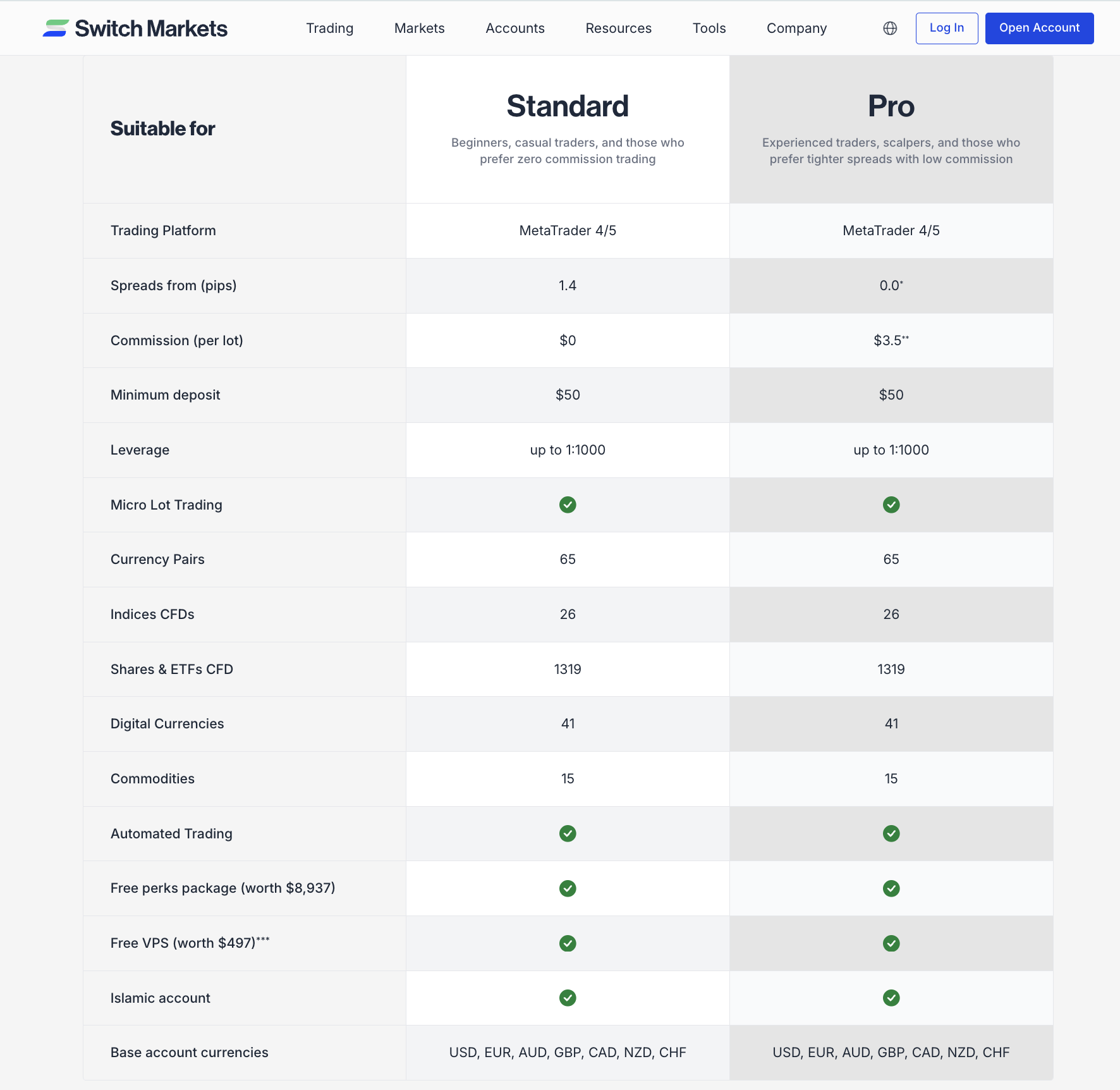
- Spread: Spreads on Switch Markets start from 0.0 pips on major forex pairs and widen with volatility and liquidity.
- Commission: Switch Markets charges $3.50 per standard lot, per side, which translates to $7.00 for a full round turn. The fee is fixed and identical across forex pairs, so your cost never depends on which currency pair you trade, and there is no confusing minimum commission to clear.
- Minimum deposit: You can open the account with $50. Many zero spread brokers ask for $200 or more, so this matters if you are starting small.
- Leverage: Leverage runs up to 1:1000, letting you control a larger position from a smaller margin. Remember that higher leverage magnifies losses as well as gains.
- Deposit and withdrawal fees: Switch Markets charges $0 to fund or withdraw, across more than 14 payment methods.
- Inactivity and maintenance fees: The Pro account carries no inactivity fees and no maintenance charges, so a quiet month costs you nothing.
- Base currencies: You can hold the account in USD, EUR, AUD, GBP, CAD, NZD, or CHF, so you can match the base currency to the one you fund and withdraw in.
- Micro lots: Trade sizes start at 0.01 lots, so you can size positions precisely and manage risk on a small balance.
- Platforms and instruments: The account runs on MetaTrader 4 and MetaTrader 5 and covers 65 currency pairs alongside shares, indices, commodities, and digital currencies.
Before you commit, scan the full schedule for other fees. Some brokers advertise a low commission, then recover the difference through withdrawal fees, currency-conversion charges, or monthly maintenance charges on a quiet account. Transparent pricing means no surprises after you fund: the spread and the commission are the whole story, with no additional fees buried in the terms. This is exactly what Switch Markets provides.
How Much Can a Zero Spread Account Save You?
Numbers make the case better than adjectives. Take one standard lot of EUR/USD, that is, 100,000 units, where each pip is worth about $10.
On a standard account at a 1.4 pip spread, crossing that spread once costs roughly 1.4 × $10 = $14 for the round turn, with no commission.
On the Pro account, the raw spread on EUR/USD often sits near 0.1 pips (about $1), and the commission is $7.00 per round turn. Your all-in cost lands close to $8.
That is roughly $6 saved on a single lot. Trade once a week, and it looks small. Trade actively, and the gap compounds fast.
At 50 standard lots a month, the standard account costs about $700, while the Pro account costs about $400. That’s a whopping $300 monthly difference, or roughly $3,600 a year, on EUR/USD alone.
As your trading volumes increase, cost efficiency stops being a detail and becomes an edge. This is why reducing transaction costs sits at the heart of nearly every high-frequency and scalping strategy. High-volume and institutional clients can also lower costs further through volume-based rebates, such as the Switch Markets VIP Customer Program.
Scale it up, and the picture sharpens. An active scalper turning over 200 standard lots a month pays roughly $2,800 on the standard account against about $1,600 on the Pro account. That’s close to $1,200 saved every month on the same volume. For active traders trading this many standard lots, the account type is no longer a preference; it is the line between a profitable system and a marginal one.
Who Is a Zero Spread Trading Account Best Suited For?
A zero spread account rewards traders whose results depend on cost and precision. It suits some trading styles far better than others.
- Scalpers who open and close many trades for a few pips each. When your target is small, a tight spread is the difference between a winning system and a losing one.
- Day traders who finish the session flat and trade often enough for spread savings to add up.
- High-frequency and algorithmic traders whose strategies fire hundreds of orders and live or die on execution cost. Raw spreads and fixed commissions make backtests and live results line up.
- News traders who need raw pricing and fast fills the moment data hits.
- High-volume and professional traders for whom even a fraction of a pip per lot becomes real money across a month of CFD trading.
- Cost-conscious traders of any size who simply want to see exactly what they pay.
- Novice traders placing occasional trades who may prefer the simpler, commission-free math of a standard account while they learn.
- Long-term position and swing traders who hold for days or weeks. For them, overnight swaps usually outweigh the spread, and a zero-commission standard account can work out cheaper overall.
So, if your edge lives in tight entries, frequent trades, or automated execution, a zero spread account is almost certainly the cheaper home for it. The right account follows from your trading strategy: match the account to the way you actually trade, not the other way round, and let your trading style decide which costs you can afford to carry.
Wrapping Up
Few brokers offer a genuine zero spread account, and fewer still make it this accessible. The Switch Markets Pro account delivers raw, ECN-style pricing with a structure built for active traders.
Setting up takes minutes, and a demo account lets you test raw pricing before you risk real money.
What makes this notable is the access. The raw quotes feeding the Pro account come from financial institutions, yet the same institutional-grade, competitive pricing opens from a $50 deposit. Pricing that once sat behind large minimums now reaches retail traders, which is exactly what a genuine zero spread account should deliver.
FAQs
Still weighing whether a zero spread account fits your trading? Here are the questions traders ask most.
Is a zero spread account really free?
No. The spread on major pairs can touch 0.0 pips, but you pay a fixed commission per lot in its place.
Do spreads ever rise above zero?
Yes. Raw spreads reflect live market conditions and price fluctuations. They are tightest during liquid sessions and can widen around major news releases or thin weekend trading. Zero is the floor, not a guarantee.
How much commission does Switch Markets charge?
$3.50 per standard lot, per side, which is $7.00 for a complete round turn. The fee is the same across forex pairs, so your cost does not depend on the currency pair you trade.
What is the minimum deposit for the Switch Markets Pro account?
$50. That sits well below the $200 many zero spread brokers require, so you can test raw pricing without committing a large balance.
Is a zero spread account good for beginners?
It can be, though many novice traders prefer the simpler math of a commission-free standard account while they learn. Once you trade often enough for spread savings to matter, switching to a zero spread account lowers your costs.
Can I use automated strategies on a zero spread account?
Yes, and it is one of the best uses for it. Algorithmic and high-frequency systems are acutely sensitive to cost, and the raw spreads plus fixed commission of a zero spread account keep your backtests and live results aligned. Both MetaTrader 4 and MetaTrader 5 run expert advisors and custom technical indicators, and Switch Markets adds a free VPS and a TradingView-to-MT5 bridge so your strategies can run uninterrupted.
Risk Disclosure: The information provided in this article is not intended to give financial advice, recommend investments, guarantee profits, or shield you from losses. Our content is only for informational purposes and to help you understand the risks and complexity of these markets by providing objective analysis. Before trading, carefully consider your experience, financial goals, and risk tolerance. Trading involves significant potential for financial loss and isn't suitable for everyone.