How to Trade SpaceX Stock: Your Complete Guide to Trading SPCX
- What Is SpaceX (SPCX)?
- From a Private Company to a Public Offering
- How Investors Got SpaceX Exposure Before the IPO
- SpaceX Price Performance
- How to Trade SpaceX Stocks Today
- How to Trade SpaceX Stocks on Switch Markets
- Factors That Affect the SpaceX Stock Price
- Is SpaceX Stock Worth Trading? Weighing Both Sides
- Final Word
- FAQs
For 24 years, SpaceX was the most valuable company you could not buy. That changed on 12 June 2026, when Space Exploration Technologies Corp listed on the Nasdaq under the ticker symbol SPCX, set an initial offering price of $135 per share, and raised $75 billion, making it the largest initial public offering in stock market history. The stock opened at $150, closed its first day near $161, and briefly pushed the company past a $2 trillion valuation. Within hours, SPCX was the most-bought stock among individual investors in the United States.
If you have been waiting for a way to trade SpaceX, the wait is over. This guide explains what SpaceX is, how it moved from a privately held company to a publicly traded one, how investors chased SpaceX exposure before the IPO, and how you can trade SpaceX stocks today, either by buying shares through a brokerage account or by trading SPCX as a CFD with Switch Markets.
What Is SpaceX (SPCX)?
Space Exploration Technologies Corp, known to almost everyone as SpaceX, is an American aerospace and technology company founded by Elon Musk in 2002. Its headquarters sit at the Starbase development site in Texas, and it employs roughly 22,000 people. The mission – to make humanity multiplanetary – once sounded like science fiction. Today, SpaceX launches more orbital rockets each year than any other provider, public or private, and it works closely with NASA and the United States military on government contracts.
The company runs three businesses. The Space segment designs, builds, and flies reusable rockets, from the workhorse Falcon 9 to the deep-space Starship system. The Connectivity segment is Starlink, the satellite internet network that now serves more than 10 million subscribers across 160 countries and generated $11.4 billion in revenue in 2025 at a 63% EBITDA margin. The third segment ties SpaceX to artificial intelligence through Musk's wider technology group. Starlink, in particular, gives the company a profitable engine and a vast total addressable market, and it anchors the bull case for the stock.
SpaceX Stock Ticker Symbol and Listing
SpaceX trades on the Nasdaq Global Select Market under the stock ticker symbol SPCX. On financial data pages such as Yahoo Finance or Google Finance, and on your broker's platform, you will sometimes see the full legal name, Space Exploration Technologies Corp. Whichever source you check the current stock price on, the ticker symbol to search for is SPCX.
From a Private Company to a Public Offering
Understanding how SpaceX reached the public markets explains why the stock drew such fierce investor demand.
For most of its life, SpaceX was a privately held company. Its shares did not trade on public stock exchanges, and its valuation was set in private funding rounds rather than by the open market. That structure rewarded early investors and employees, yet it locked out almost everyone else. Ordinary individual investors simply could not buy SpaceX stock.
The initial public offering rewrote the rules. After filing with the Securities and Exchange Commission and completing the standard IPO process, SpaceX priced its public offering at an initial offering price of $135 per share and floated on 12 June 2026. The offering raised $75 billion at an implied valuation of roughly $1.77 trillion, and on its first day, SpaceX surpassed Tesla to become the sixth most valuable public company in the United States.
One detail set this IPO apart. SpaceX allocated up to 30% of the offering to retail buyers and distributed those allocated shares through brokerages including Charles Schwab, Morgan Stanley's E*TRADE, Robinhood, Fidelity, and SoFi Technologies. Even so, demand outran supply. Investors who requested an allocation often received fewer shares than they asked for, and many received none. That mismatch is normal: in a hot IPO, the number of shares requested dwarfs the shares available, so you may receive fewer shares than you request (or none at all), regardless of how much you ask for.

How Investors Got SpaceX Exposure Before the IPO
Before 12 June 2026, gaining SpaceX exposure took money, patience, and accredited investor status. The routes below are no longer the only way in, but they map the pre-IPO landscape and still apply to other pre-IPO companies and future IPOs.are
Each route carried trade-offs. Secondary markets and SPVs demanded high investment minimums, charged fees, and locked your capital in until a liquidity event, and SpaceX held a right of first refusal that could cancel a pending purchase. Funds offered an easier entry (in some, SpaceX was the single largest position) yet a vehicle like Destiny Tech100 frequently traded at a steep premium to the value of its underlying holdings, so investors seeking exposure often paid well above the implied SpaceX price. None of these private-market investment choices matched the simplicity of buying a single stock on a public exchange. For traders who want a heads-up on the next big listing, most brokers now offer IPO alerts.
SpaceX Price Performance
SpaceX's price history is short, and any reading of it stays preliminary. That opening day, though, was extraordinary. The stock, priced at its $135 IPO level, opened at $150 and closed its debut near $161. That’s a first-day gain of roughly 19%. It swung between about $149 and an intraday high close to $177, and more than 500 million shares changed hands. By the closing bell, SpaceX was worth around $2.1 trillion. In its second trading day, the stock gained another 19.6% to close at $192.5.
A move like that says more about demand than about value. A thin free float met heavy retail buying, and the price can swing sharply in both directions while the market settles on what SpaceX is worth. Treat these early sessions as price discovery rather than an established trend, and expect volatility to stay high until a longer trading record builds up.
Forecasts for where SPCX heads next vary widely, which is exactly what you would expect for a company this large and this new to the public markets. The first analysts to begin coverage settled on a consensus rating of “Buy”, with an average 12-month price target around $164, which is close to where the stock already trades. The spread around that average is wide, running from roughly $63 at the low end to nearly $227 at the high end.
On the bullish side, Wolfe Research opened coverage with a Buy rating and a $175 target by the end of 2027, reasoning that Starship and Starlink can grow into the valuation if Starship begins payload launches on schedule. On the cautious side, at least one analyst set a sell rating with a target near $115 (below the IPO price). That gap captures the debate in a line: large potential weighed against equally large execution risk, set against 2025 revenue of about $18.67 billion and a net loss of roughly $4.94 billion.
None of these targets is a promise. With so little trading history, SpaceX has almost no past performance to lean on, and analyst forecasts will move as fresh data arrives.
How to Trade SpaceX Stocks Today
Now that SpaceX is publicly traded, you no longer need to be an accredited investor or chase shares through private markets. SPCX trades on a public exchange like other individual stocks, and any individual investor with a brokerage account can take a position. You have two broad ways to do it.
The first is to buy SpaceX stock outright. You open a brokerage account, fund it, search for the ticker SPCX, and purchase shares at the current stock price. You own a slice of the company, you can sell stock whenever the market is open, and you profit only if the share price rises.
The second is to trade SPCX as a Contract for Difference (CFD). A CFD is an agreement to exchange the difference in a stock's price between the moment you open a trade and the moment you close it. You never own the underlying shares; you trade the price movement. This route has two features outright ownership lacks: you can go short as readily as you go long, and you can use trading leverage to control a larger position with a smaller deposit. Both features cut both ways, amplifying losses as easily as gains. If you want the mechanics in full, read our guide to CFD trading.
How to Trade SpaceX Stocks on Switch Markets
At Switch Markets, you can trade SpaceX as a share CFD on the MetaTrader 5 (MT5) platform, going long or short without owning the underlying stock. It lists under the symbol SPCX.US, and these are its key instrument details and trading conditions at Switch Markets:
In practice, the 50% margin requirement means you fund half of each position’s value, and a single account can hold up to 300 SpaceX shares. To start trading SPCX, follow these steps.
- Open an online trading account with Switch Markets.
- Fund your trading account using one of our funding methods.
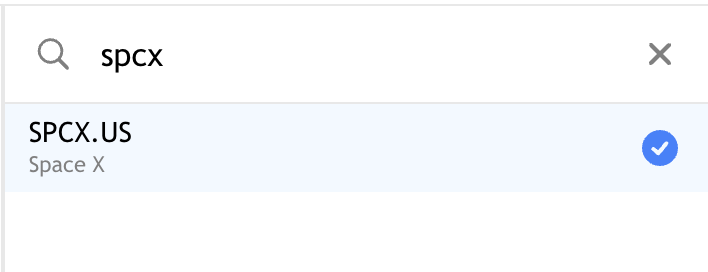
Search for SpaceX (SPCX.US) on your platform and follow what is moving the stock. Lean on fundamental analysis to frame your view.
Click on the New Order button, and a window will pop up on the left side of the platform.
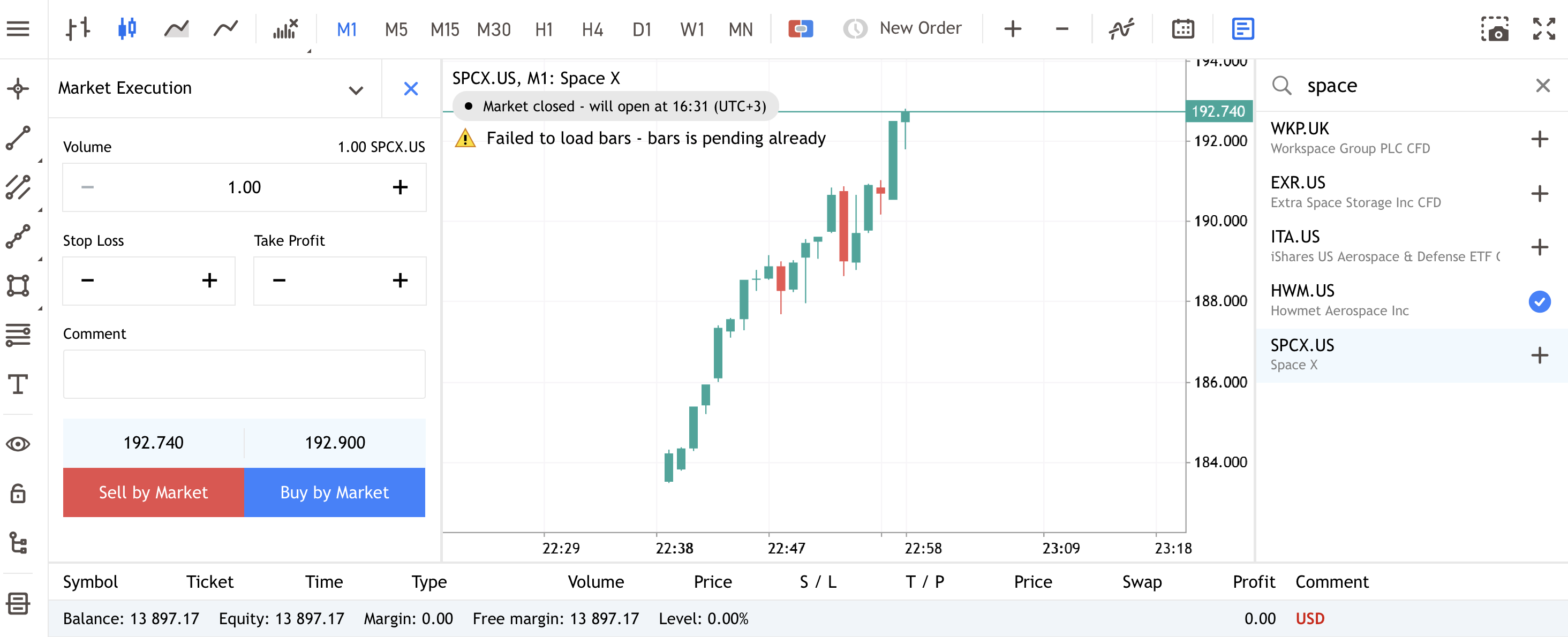
- Decide your direction. Buy (go long) if you expect the share price to rise, or short-sell if you expect it to fall.
- Protect every position with risk management tools such as a stop-loss order and a sensible risk-reward ratio, and never trade with funds you cannot afford to lose.
Factors That Affect the SpaceX Stock Price
SpaceX trades like any other high-growth stock: its price reflects the balance of buyers and sellers, shaped by news and sentiment. Watch these factors in particular.
- Investor demand and sentiment: SpaceX is one of the most closely followed stocks in the world, and retail enthusiasm drove enormous volume on its debut. Hype can lift the price quickly and drop it just as fast.
- Starlink and segment growth: Starlink is the profit engine. Its subscriber numbers, revenue, and margins move the investment case more than almost anything else.
- Earnings reports: As a public company, SpaceX now reports results on a schedule. Each report is a catalyst that can spark sharp moves. The next SpaceX earnings report is expected to be released at the end of June or early August.
- Key-person risk: SpaceX is tied tightly to Elon Musk. News about his role, his other companies, or his public conduct can swing the stock.
- Valuation debate: At a price-to-sales multiple above 100 and with net losses on the books, SpaceX carries a rich valuation. Any shift in how the market judges that premium moves the price.
- Lock-up expiries: When early shareholders and employees become free to sell, the extra supply of shares can pressure the price.
- Broader market conditions: Interest rates, risk appetite, and the wider mood toward technology and space stocks all feed into SPCX.
Is SpaceX Stock Worth Trading? Weighing Both Sides
Strong opinions surround SPCX, and a balanced view serves you better than the hype.
The bull case rests on scale and ambition. SpaceX dominates global launch, owns a profitable and fast-growing Starlink business, and addresses a space economy that supporters expect to expand for decades. They argue that no rival comes close and that a premium is justified for a company that defines its industry.
The bear case rests on price. Some analysts called the IPO valuation stretched; one issued a sell rating with a price target below the offering price, pointing to a price-to-sales multiple above 100 and to net losses that ran deep in 2025. One key metric that might pressure the stock downward is the P/E ratio, which is extremely high. Add key-person risk and looming lock-up expiries, and the stock looks expensive to skeptics.
Both cases can hold true at different times, which is why SPCX may stay volatile. Investing involves risk, and a newly listed, richly valued stock carries it to a high degree, so base your decisions on your own investment objectives, your risk tolerance, and your own research rather than on headlines.
Final Word
In sum, SpaceX spent 24 years as the most coveted private company in the world, reachable only through accredited-investor channels, secondary markets, and a handful of funds. Its historic Nasdaq listing changed that overnight. Today, adding SpaceX to your investment choices is as simple as searching for SPCX, and Switch Markets lets clients trade it as a CFD - long or short, with leverage - alongside thousands of other markets. As with any newly listed, richly valued stock, the opportunity carries real risk, so size your positions carefully and lean on solid risk management. If you would rather practice first, a free demo account is the place to start.
FAQs
Here are some common questions about trading SpaceX stocks.
What is the SpaceX stock ticker symbol?
SpaceX trades on the Nasdaq under the ticker symbol SPCX, listed under its legal name, Space Exploration Technologies Corp.
How do I check the current SpaceX stock price?
Search for the ticker SPCX on any major financial data source, such as Yahoo Finance or Google Finance, or view the live price directly on your Switch Markets trading platform.
Can I short SpaceX stock?
Yes. Trading SPCX as a CFD lets you go short and profit if the price falls, as well as go long. Buying shares outright, by contrast, profits only when the price rises.
What was the SpaceX initial offering price?
SpaceX priced its initial public offering at $135 per share. The stock then opened at $150 and closed its first session near $161.
Do I need to be an accredited investor to buy SpaceX stock now?
No. Accredited investor status mattered only for pre-IPO private-market access. Now that SPCX trades on a public exchange, any individual investor with a brokerage account can buy and sell the stock.
Risk Disclosure: The information provided in this article is not intended to give financial advice, recommend investments, guarantee profits, or shield you from losses. Our content is only for informational purposes and to help you understand the risks and complexity of these markets by providing objective analysis. Before trading, carefully consider your experience, financial goals, and risk tolerance. Trading involves significant potential for financial loss and isn't suitable for everyone.