How to Trade Anthropic (ANT) Shares: A Guide for Traders
- What Is Anthropic (ANT)?
- From a Private Company to a Public Offering
- How Investors Chased Anthropic Shares Before the IPO
- Inside the Anthropic IPO: Price, Share Count and Valuation
- What Anthropic's S-1 Reveals About Revenue, Losses and Spending
- Anthropic Price Performance
- How to Trade Anthropic Shares on Switch Markets
- Factors That Affect the Anthropic Stock Price
- Final Word
- FAQs
Five years ago, Anthropic was a small group of AI researchers with a bet that safety would sell. On 19 November 2026, it took that bet to Nasdaq as the largest IPO in history.
The maker of Claude priced its shares at $83, above its own $70 to $78 range, and raised about $81.3 billion. That beats the record SpaceX set in June and values the company at roughly $1.5 trillion.
Until now, most people who wanted a piece of Anthropic had to settle for pre-IPO tokens and side deals, many of which the company later declared void. With the stock trading under the ticker ANT, you can now take a position in either direction.
Here's how to trade Anthropic shares, what the prospectus reveals, and what could move the price next.
What Is Anthropic (ANT)?
Anthropic was founded in 2021 by seven former OpenAI researchers, led by siblings Dario and Daniela Amodei, with the aim of building powerful AI systems that are also safe to use.
Its core Anthropic product is Claude, a family of AI models that companies use to draft documents, analyze information and, increasingly, write code. Businesses reach Claude through Anthropic's own apps and API, or through Amazon Web Services, Google Cloud and Microsoft Azure.
By 30 September 2026, more than 11,900 customers were each paying Anthropic at least $100,000 a year, including more than 1,900 above $1 million and about 250 above $10 million. A growing share of that business comes through the cloud platforms. Sales through their marketplaces rose from about 11% of revenue in 2023 to 48% in the first half of 2026, with each provider taking a cut.
Unlike most listed companies, Anthropic is a public benefit corporation (PBC), which means its directors must weigh shareholder returns against a stated mission of developing advanced AI responsibly, for humanity's long-term benefit.
Public investors buy Class A common stock, which carries one vote per share. Most of the voting power sits elsewhere: a single Class F share held by the founders carries 50.1% of general voting power, and an independent Long-Term Benefit Trust elects a majority of the board. ANT buyers therefore get full exposure to Anthropic's growth, but limited voting rights.
That growth is what has drawn investors, and it explains how quickly the company's private valuation climbed in the year before the IPO.
From a Private Company to a Public Offering
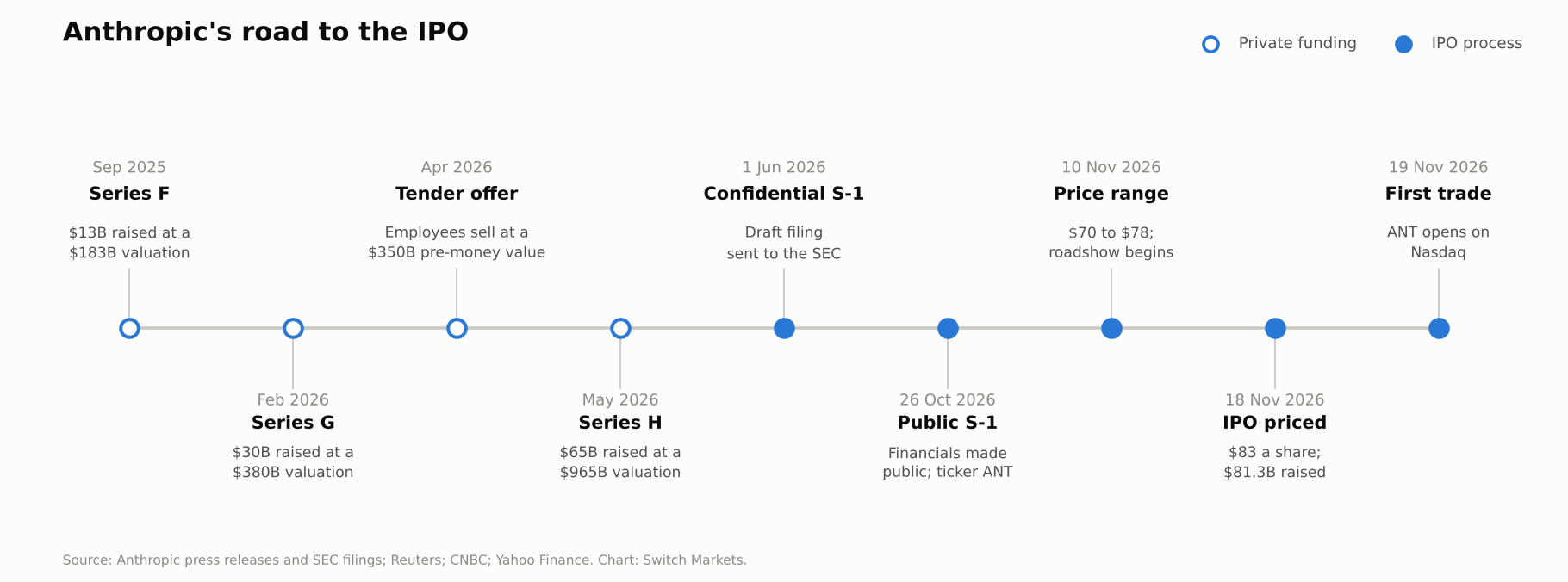
Between September 2025 and May 2026, Anthropic's post-money valuation rose from $183 billion to $965 billion. It raised the money the usual way for a venture-backed company, through lettered funding rounds priced by lead investors and approved by its board, but at a pace few private companies have matched.
When the Series G closed, Anthropic put its annualized run-rate revenue at about $14 billion. By the time it announced the Series H, that figure had passed $47 billion, and the new valuation moved it ahead of OpenAI as the most valuable private AI company, Reuters reported.
The listing process began just days later, with a confidential filing to the US Securities and Exchange Commission (SEC) on 1 June. Anthropic had been aiming for October, but it pushed the timetable back so investors could see a full quarter of results. The public S-1 arrived on 26 October, the $70 to $78 price range on 10 November, and the final pricing on 18 November.
Before that listing date, demand for Anthropic shares had no official outlet, and much of it ended up in riskier corners of the market.
How Investors Chased Anthropic Shares Before the IPO
For years, Anthropic stock belonged to a short list: founders, employees, venture funds, and partners such as Amazon and Google. Everyone else had to find a side door into the private markets.
The table below shows the main routes investors used and whether Anthropic recognized each one.
Of these routes, only shares that passed through Anthropic's board gave buyers ownership the company would recognize.
In May 2026, Anthropic warned that any sale or transfer of its stock without board approval is void and will not be recognized on its books. It also named platforms it said were not authorized to sell its shares, including Unicorns Exchange, which said it then stopped offering them.
On 12 May, a tokenized Anthropic product implied a valuation of about $1.5 trillion, roughly four times the company's last funding-round price at the time. Buyers of those tokens got exposure to a price and nothing more: no voting rights, no stockholder rights, and no place in the share count.
Since the IPO, anyone with a brokerage account can buy Anthropic common stock that the company recognizes, and the terms of that offer are now public.
Inside the Anthropic IPO: Price, Share Count and Valuation
Anthropic set its initial terms on 10 November, offering 825 million shares at $70 to $78 each. Strong investor demand during the roadshow led the company to raise both the price and the number of shares before it priced the deal on 18 November. The final terms are below.
At $83 a share, investors valued Anthropic at about one and a half times the $965 billion it was worth in its May funding round, according to PitchBook. For traders, the IPO price is also the first reference level, the one early moves in ANT will be measured against.
Because the $1.5 trillion figure is fully diluted, it includes stock options, restricted stock units and convertible securities that could turn into shares later. Valuations based only on shares outstanding are lower, so it's worth checking which measure a report uses before comparing numbers.
By 15 November, investors had placed orders for nearly seven times the shares on offer, Bloomberg reported. Anthropic used that demand to price above its range and add 155 million shares to the deal.
Alongside the public offering, Nvidia, Google, AMD, Broadcom, Micron, Microsoft and TSMC agreed to buy $26.0 billion of Anthropic stock at the IPO price. Several of these companies also sell Anthropic the chips and cloud capacity it relies on, which gives them a commercial interest in its growth as well as a financial one. The underwriters, for their part, can buy up to 147 million extra shares within 30 days of the listing, an option banks commonly use to help steady a new stock's price in its first weeks.
Up to 20% of the offering went to retail investors, more than the 5% to 10% usual for large US IPOs. With orders so far ahead of supply, though, many applicants were expected to receive few shares or none. Most traders will get their exposure in the open market instead, including through CFDs.
With the deal terms set, the next step is to look at what Anthropic's S-1 says about the business behind them.
What Anthropic's S-1 Reveals About Revenue, Losses and Spending
Anthropic made $41 million in revenue in 2023, its first year of commercial sales. In the third quarter of 2026 alone, it brought in $16.96 billion, up 1,127% from a year earlier, taking revenue for the first nine months of the year to $33.24 billion. Those figures come from its S-1 registration statement and two amendments, the most complete public information investors have on the business.
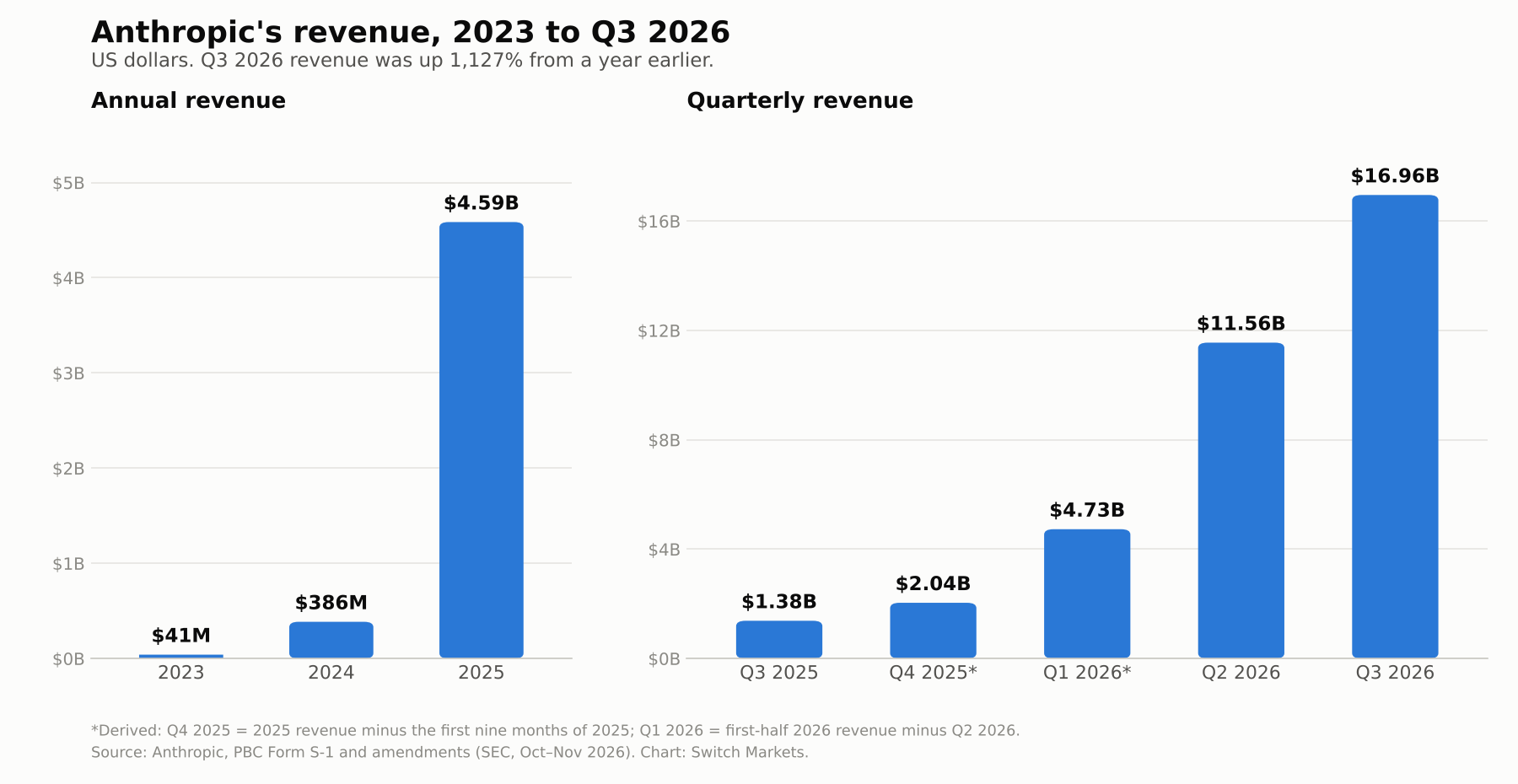
In the second quarter of 2026, Anthropic posted an operating profit of $974 million. Three months later, it reported a $567 million operating loss, with price cuts and contractual discounts taking about $600 million off third-quarter revenue. Growth cooled over the same stretch: revenue rose 47% from the previous quarter, compared with 144% in the quarter before.
So why does the S-1 show a net loss of about $104 billion for the first nine months of 2026? Most of it is an accounting effect rather than money leaving the business. In the first half alone, $72.4 billion of the $80.7 billion net loss came from changes in the fair value of convertible notes and SAFEs. Those instruments rise in value on paper as Anthropic's own valuation climbs.
On the balance sheet, Anthropic held $95.6 billion in cash and $36.3 billion in short-term investments as of 30 September. It has also signed up for about $895.4 billion in purchase and lease commitments, almost all of it for compute and infrastructure. Whether revenue can keep growing faster than that spending is one of the main questions traders will be watching.
Net revenue retention stood at about 900% at the end of September, meaning qualified customers were spending roughly nine times what they spent a year earlier. That spending is concentrated, though, with the top five customers accounting for about 25% of revenue in the first nine months of 2026.
Anthropic does not expect to pay dividends for the foreseeable future, and the S-1 puts it bluntly: "capital appreciation, if any, will be your sole source of gain." Any return on ANT has to come from the share price, which is where the market's verdict on these numbers shows up first.
Anthropic Price Performance
ANT began trading on Nasdaq on 19 November 2026, a day after Anthropic priced its shares at $83, $5 above the top of its marketed range.
Earlier on pricing day, perpetual futures on the crypto exchange Hyperliquid implied about $96 a share, roughly 25% above the offer price. That gives a sense of how much upside some traders were pricing in, although those contracts confer no ownership and say nothing certain about where Nasdaq trading will open.
SpaceX, the last record-setting IPO, priced at $135 in June, opened at $150 and closed its first day near $161. A strong debut doesn't settle the longer-term picture, however. With that kind of volatility in play, how you trade ANT matters as much as what you think of the company.
How to Trade Anthropic Shares on Switch Markets
Now that ANT is listed, you can either buy the shares through a stockbroker, which gives you common stock and one vote per share, or trade a contract for difference (CFD) on the price.
With a CFD, you give up stockholder rights in exchange for flexibility. You can sell as easily as you buy, which suits a volatile new listing, and you trade with leverage, which magnifies losses as well as gains. New to CFDs? Our beginner's guide to CFD trading and our explainer on how leverage works cover the basics.
Switch Markets offers more than 1,500 share and ETF CFDs, with the widest range on MetaTrader 5. That lets you trade Anthropic's price movements in either direction from the same platform you may already use for forex, indices and commodities.
Here is how to place your first trade:
- Open an online trading account with Switch Markets: If you want to practice first, start with a demo account and switch to live once you are comfortable with how the stock moves.
- Fund your trading account using one of our funding methods: The minimum deposit is $50, and deposits carry no fees.
- Search for Anthropic (ANT.US) on your platform and follow what is moving the stock: Lean on fundamental analysis to frame your view: earnings dates, lock-up expiries and AI-sector news all move the price.
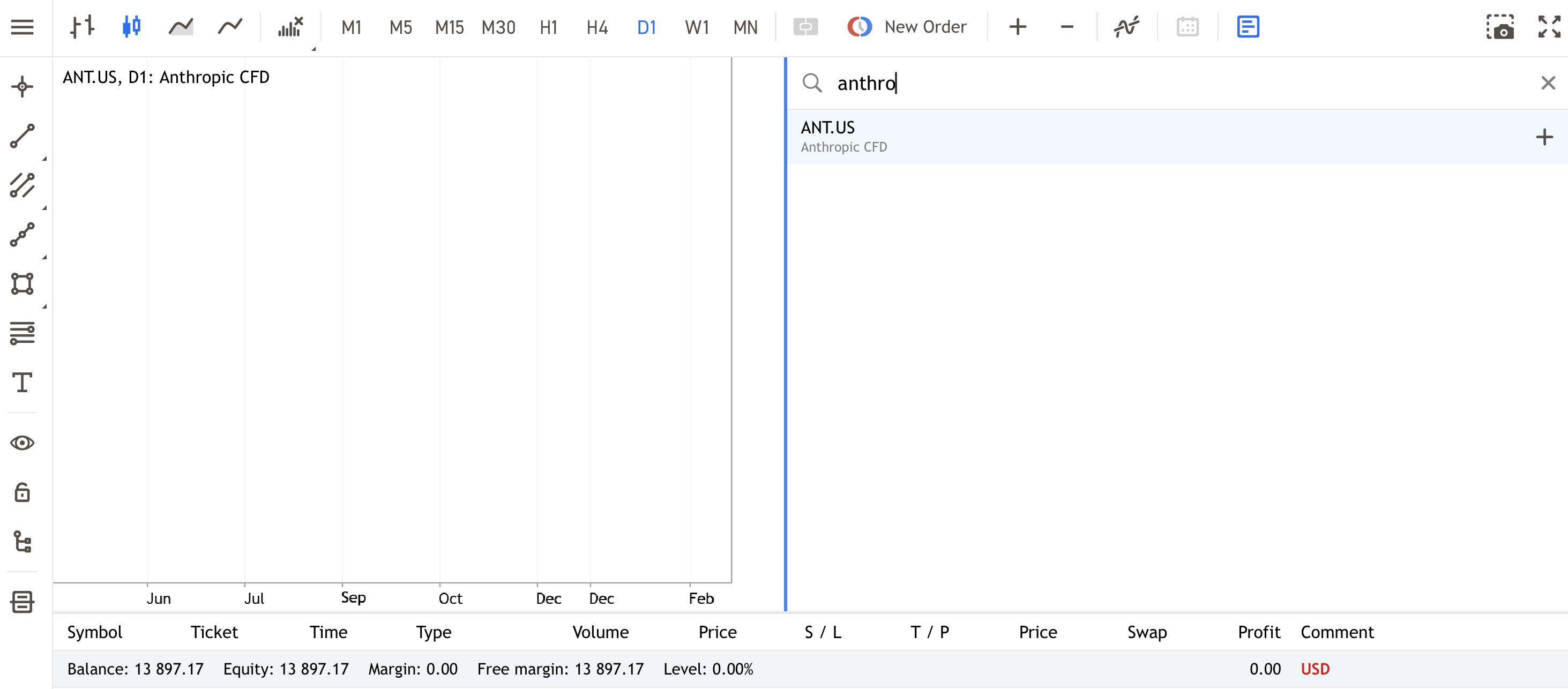
- Click on the New Order button, and a window will pop up on the left side of the platform: Enter your position size in lots and check the margin the trade will use.
- Decide your direction: Click Buy if you expect the ANT price to rise, or Sell if you expect it to fall.
- Protect every position with risk management tools: Set a stop-loss at the level where your idea is proven wrong, size the trade so that a stop-out costs only a small share of your account, and aim for a reward that justifies the risk. A new listing can gap through levels, so give the stop room and keep the position small. Our guide to CFD trading strategies explains why many traders risk no more than 1% to 2% of their account on a single trade.
Once your trade is open, the next thing to understand is what moves the ANT price.
Factors That Affect the Anthropic Stock Price
In its first days, ANT is likely to trade largely on sentiment. Over time, the price will respond to the same forces that drive any large technology stock, along with several that are specific to Anthropic.
Earnings and growth rate: Anthropic's revenue is still growing at a pace few companies have matched, but the quarter-on-quarter rate slowed from 144% to 47% between the second and third quarters. Every earnings report will be judged on whether growth holds up, not just whether revenue rises.
AI pricing pressure: Price cuts and discounts took about $600 million off third-quarter revenue. If competition keeps pushing down what customers pay for AI, Anthropic has to sell much more volume to grow at the same rate.
Compute costs and commitments: The company has signed up for about $895.4 billion in purchase and lease commitments, mostly for chips, servers and cloud capacity, which ties its fortunes to the semiconductor market. Margins will depend on whether revenue grows faster than what the company must spend on them.
Customer concentration: With the top five customers making up about a quarter of revenue, news about any large client, positive or negative, can move the stock.
Competition: OpenAI, Google and other model developers are chasing the same enterprise budgets. Google and Amazon are also Anthropic investors and cloud suppliers, a relationship the S-1 flags as a potential source of conflicts of interest.
Lock-up expiries: Most existing holders, covering about 15.5 billion shares, are locked up for up to 180 days after the IPO, and co-founders and some holders of more than 0.5% of fully diluted shares for up to 365 days. About 3.6 billion shares may become sellable earlier. As each window opens, the supply of tradable shares jumps, which often weighs on new listings. On a 180-day count, the first major date falls around mid-May 2027. Much of that stock belongs to early investors and to employees whose settled RSU shares landed in their accounts at the IPO, many of whom will be looking to cut their concentration risk once they can sell.
Interest rates, inflation and risk appetite: Expensive growth stocks are sensitive to the cost of money. Rising inflation or higher rate expectations tend to hit them hardest, and ANT will also move with the Nasdaq and the wider AI trade. Even the IPO's final pricing was expected to depend partly on how the market reacted to Nvidia's earnings.
Final Word
If you plan to trade ANT, decide first whether you want to own the stock or trade its price, then build each position around a clear plan and a stop-loss. A demo account is a sensible place to start if you're new, and you can move to a live account once you're comfortable.
If you prefer trading CFDs, Anthropic (ANT) is available on Switch Markets, offering exposure to its share price without owning the underlying stock. The instrument offers leverage of up to 5:1 and a low minimum deposit, so you can get started with a relatively small initial amount. As always, leverage can magnify both gains and losses, so make sure you understand the risks and choose a position size that fits your trading plan.
FAQs
The questions below cover what traders ask most often about ANT.
What is the Anthropic stock ticker symbol?
Anthropic trades under the ticker ANT on the Nasdaq Global Select Market. The listed security is Anthropic, PBC Class A common stock, which carries one vote per share.
What was the Anthropic IPO price?
Anthropic priced its IPO at $83 a share, above the marketed range of $70 to $78. It sold 980 million shares and raised about $81.3 billion, the most ever raised in an IPO.
Can I short Anthropic stock?
Yes. With a CFD, you can open a sell position as easily as a buy position. Shorting the actual shares requires your broker to locate shares to borrow, which can be difficult in the first days after a listing.
Do I need to be an accredited investor to buy Anthropic stock now?
No. Before the IPO, private shares were largely limited to accredited and institutional investors. Now that ANT is listed, anyone with a brokerage or trading account that offers US shares can trade it, subject to local rules.
Risk Disclosure: The information provided in this article is not intended to give financial advice, recommend investments, guarantee profits, or shield you from losses. Our content is only for informational purposes and to help you understand the risks and complexity of these markets by providing objective analysis. Before trading, carefully consider your experience, financial goals, and risk tolerance. Trading involves significant potential for financial loss and isn't suitable for everyone.