
How to Trade the Semiconductor Market: A Quick Guide for Traders
- What Is the Semiconductor Industry?
- Why Trade the Semiconductor Market?
- The Philadelphia Semiconductor Index (SOX)
- What Drives Semiconductor Stocks?
- Semiconductor Market Price Performance
- How to Analyze the Semiconductor Index
- Ways to Trade the Semiconductor Market
- Key Strategies for Trading SOXX
- How to Start Trading the Semiconductor Market
- Wrapping Up
- FAQs
Few markets are as volatile as semiconductors, especially with the recent AI boom and AI bubble. The Philadelphia Semiconductor Index (SOX), for example, which tracks 30 of the world's largest companies involved in semiconductor design, manufacturing, distribution, and sales, has more than doubled in the first half of 2026. However, this has been followed by a fall of nearly 30% over 5 weeks. It has bounced back but then fallen again in October, only for buyers to come back again.
Due to its volatility, many traders would like to know how to trade this market. You will need to use two tickers. The first is the benchmark ticker for the sector: the Philadelphia Semiconductor Index (SOX). The second is a tradable product: the iShares Semiconductor ETF (SOXX). This can be traded as a CFD on Switch Markets.
In this guide, we will take a look at how the semiconductor industry works, what affects chip stocks, what has happened in this sector, and how to analyze and trade it using SOXX.
What Is the Semiconductor Industry?
Semiconductors are small chips used for processing, storing, and transmitting data. They are fundamental to many sectors of technology such as smartphones, laptops, electric cars, medical devices, and servers used in artificial intelligence, making it an important part of modern technology and the stock market.
The companies involved can be split into further subsectors:
- Fabless designers: fabless companies like Nvidia, AMD, Broadcom and Qualcomm design chips and their chip architecture but outsource production.
- Foundries: TSMC and Samsung Foundry manufacture chips for other firms. TSMC alone is worth well over $1 trillion. Intel designs chips and also runs its own plants.
- Memory makers: Micron, SK Hynix and Samsung make DRAM, high-bandwidth memory and storage chips.
- Equipment makers: Applied Materials, Lam Research, KLA and ASML build the machines that produce semiconductors, including tools for advanced packaging.
- Analog and automotive semiconductors: Texas Instruments, NXP and ON Semiconductor make traditional semiconductors that manage power and signals in cars, factories and consumer devices.
It is an intensely capital-intensive industry, with the latest fabrication plants costing tens of billions of dollars to build. Leaders are separated from the rest with high investment in R&D and a low cost structure.
The industry has expanded rapidly, with worldwide sales reaching approximately $574 billion in 2022. Sales fell 8.2% in 2023 as customers worked through excess inventory, before rebounding to $791.7 billion in 2025, according to the Semiconductor Industry Association (SIA). The growth is expected to accelerate further in 2026, with Gartner forecasting worldwide semiconductor revenue of approximately $1.6 trillion, driven largely by continued investment in AI infrastructure and data centers. A few years back, it was predicted that the market would be worth $1 trillion by 2030, growing at roughly 8% a year. AI demand got it there early: SIA reported that sales topped $1 trillion within the first eight months of 2026. Sales grew 180.9% in August in the Americas.
The market leaders have also changed. Intel and Samsung have held the top spot globally for years, but this changed in 2025 when Nvidia, the provider of AI processors for data centers and autonomous systems, took the lead with $125.7 billion in chip revenue. This was ahead of Samsung, SK Hynix, and Intel. Broadcom, which provides solutions that utilize wireless networks and cybersecurity systems, came in at seventh place.
Why Trade the Semiconductor Market?
Semiconductor investing has long attracted active traders, and 2026 shows why.
- Volatility: SOXX has a beta of about 2, so it has tended to move roughly twice as much as the S&P 500. In May and June 2026 alone, the SOX logged nine daily gains of 5% or more.
- Liquidity: SOXX holds more than $43 billion in assets and trades millions of shares a day.
- Exposure to AI: chipmakers supply the hardware behind AI. In June 2026, semiconductor stocks made up a record 19.7% of the S&P 500.
- Two-way opportunities: CFDs let you go long or short, which matters in a sector that falls as hard as it rises.
- Regular catalysts: earnings, SIA sales data, and central bank decisions give you a steady calendar of events to plan around.
Another factor worth considering is the industry's cyclical nature. Semiconductor demand moves in waves, with periods of strong orders and capacity expansion often followed by inventory corrections and slower demand. These cycles can create significant price movements, particularly when investors reassess earnings expectations or the outlook for AI infrastructure spending. For active traders and scalpers, this means there are opportunities not only around major earnings announcements but also when the market starts pricing in a change in the industry's growth cycle.
The Philadelphia Semiconductor Index (SOX)
One of the best ways to get exposure to the semiconductor market is through the SOX index. The Philadelphia Semiconductor Index (officially known as the PHLX Semiconductor Sector Index [SOX]) is the most widely watched index of semiconductor markets. The index was created in December 1993 and is currently maintained by Nasdaq. It measures the performance of 30 leading semiconductor companies involved in designing, manufacturing, distributing, and selling semiconductor products.
It is a market capitalization-weighted index, which means that larger companies have greater weighting within the index. To avoid an individual company becoming too dominant, there are limits in place. As at the end of June 2026, the largest weights are Nvidia (10.34%), Micron (8.65%), Broadcom (7.69%) and Applied Materials (5.84%).
Can You Trade the SOX Index Directly?
No, not directly. The SOX is a calculation, not an asset you can buy. The only way to trade the index is via options.
Switch Markets doesn't offer it, but it does offer SOXX, which holds largely the same group of chip stocks in a tradable form.
SOXX is the iShares Semiconductor ETF, which is one of the largest semiconductor ETFs. A single SOXX position, or SOXX CFD, gives you exposure to Nvidia, Micron, AMD, Broadcom, Intel, TSMC, and other leaders at once.
SOX vs SOXX: What's the Difference?
SOX is the scoreboard, and SOXX is what you trade. Until June 21, 2021, SOXX was a proxy for SOX, but now it tracks the NYSE Semiconductor Index. Both have similar constituents; therefore, they typically move in line with each other. However, they have different weightings, so they will not be perfectly correlated. The 8% cap means it is more diversified than SMH (VanEck Semiconductor ETF), which had around 22% of its fund invested in Nvidia back in August 2026.
SOXX Top Holdings
What would you be buying/selling if you were to trade SOXX? While it contains 34 stocks, 62% of it is concentrated in 10 companies. So a handful of companies do most of the heavy lifting.
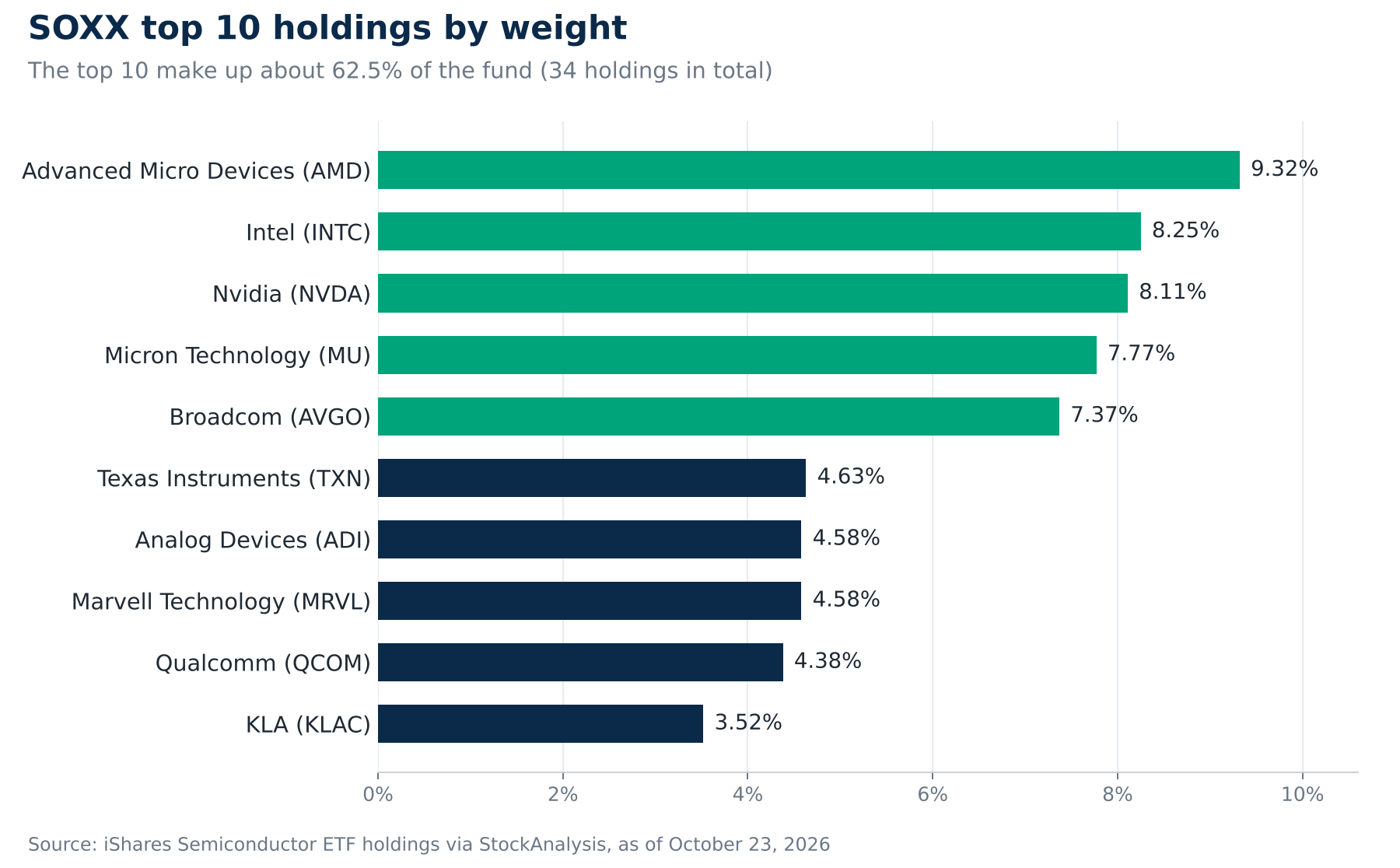
Note that AMD has gone over 8%; this is because the weightings are reset every quarter. In between quarters, the weightings will change with the price of the stock. This means they often change order. For example, Micron was the largest holding in May.
They also have quite a varied weighting. They include chip designers such as AMD and Nvidia, as well as memory, analog, and equipment stocks. This means it tends to be more resilient than just an Nvidia fund if the AI names start to go down.
What Drives Semiconductor Stocks?
Stock prices across the semiconductor sector respond to a handful of forces. Knowing them is the starting point for any rigorous analysis.
1. AI Demand and Capital Expenditures
The AI chip sector is in a structural growth phase due to large capital expenditures increasing by major cloud players, with Meta expecting to invest $135 billion to $145 billion in 2026 alone. This has a knock-on effect on pricing and inventory within the sector.
Micron has mentioned that the supply of memory is under pressure due to AI. On October 28th 2026, SK Hynix stated they are sold out until 2029. Although newer concepts such as quantum computing will increase demand going forward, AI is driving most of the current earnings.
This trend means that the increased capital expenditure from companies investing in new facilities can cause an oversupply in the market a few years down the line. If there are any signs of a slowing in the level of investment being made into AI, then chip stocks can suffer quickly.
2. The Semiconductor Cycle
The semiconductor industry is highly cyclical, with periods of strong demand often followed by inventory corrections and slower growth. When demand outstrips supply, chip prices rise, and manufacturers increase production to take advantage of the opportunity. However, building new manufacturing capacity takes time and requires substantial investment. By the time new facilities and production lines come online, demand may have already started to cool. This can leave manufacturers and customers with excess inventory, putting downward pressure on prices and sales.
This is essentially what happened in 2023. Following the strong demand of previous years, particularly during the pandemic, customers began working through excess chip inventories. Manufacturers also slowed investment as the market adjusted to weaker demand. The result was an 8.2% decline in global semiconductor sales. Eventually, inventories normalized, demand recovered, and the industry returned to growth. This cyclical pattern is important for traders because it means semiconductor stocks can experience sharp swings as investors anticipate changes in supply, demand, and earnings expectations.
3. Interest Rates and Monetary Policy
Chip stocks are heavily influenced by expectations of future growth, making monetary policy an important factor. When interest rates rise, the present value of future earnings falls, while borrowing costs increase, making it more expensive for semiconductor companies to finance new factories and expand production capacity. Higher rates can also make safer investments, such as government bonds, more attractive compared with riskier growth stocks. These concerns contributed to the SOX's $1.6 trillion decline in mid-October 2026.
4. Geopolitical Factors and Supply Chain Risk
The semiconductor industry is concentrated in East Asia, specifically within Taiwan and South Korea. This exposes the supply chain to political risk. Trade barriers and export regulations on advanced chips to China are always at risk of impacting the supply chain.
In October 2026, it was reported by The Washington Post that Malaysia seized servers believed to contain advanced AI chips in breach of US export controls.
The industry also faces physical risks. For instance, the pandemic caused significant disruption to the supply chain in 2020. However, governments are taking action to combat this. Laws such as the US CHIPS and Science Act are being used to divert long-term capital towards domestic production.
While all of these are great steps in the right direction, there are still gaps within the industry. In April 2026, Willy Shih (Professor at Harvard Business School) and PJ Lin wrote an article for Harvard Business Review arguing that the US still relies on Asia for the latter stages of production, such as testing and packaging.
Semiconductor Market Price Performance
2025 – The SOX gained approximately 42% over the year, although it got off to a slow start. The index fell more than 14% in the first quarter amid concerns over tariffs, but rebounded strongly in April after the tariff pause was announced.
January–June 2026 – Semiconductor stocks surged as demand for AI infrastructure continued to grow. The SOXX jumped 40% in April, followed by gains of 23% in May and nearly 13% in June. Meanwhile, the SOX reached a record high of 14,634.72 on June 22, more than doubling from its level at the start of the year.
October 2026 – The SOX suffered a sharp selloff, losing approximately $1.6 trillion in market value over just six days. Investors grew concerned about interest rates, high valuations, and the rising cost of AI development. On October 22, Lam Research warned of potential supply constraints that could limit production in 2027. The announcement added to the pressure, sending the SOX down 6.72% to 10,732, its lowest closing level since late July.
Sentiment improved after Anthropic filed for an IPO on October 26, helping the index rebound by 2.82%. The recovery continued on October 28, when the SOX gained another 1.75% to reach 11,684, following a record quarter from SK Hynix. On the same day, the Federal Reserve held interest rates steady at 3.75%–4.00%, although two officials voted in favor of a rate increase. Despite the rebound, the index remained around 20% below its June highs.
Opinions remain divided on the sector's outlook. On October 26, Morgan Stanley warned that semiconductor stocks could fall another 10%–15% before reaching a bottom. In the near term, the SOXX's November 5 split and Nvidia's earnings report later in the month could serve as important catalysts.
How to Analyze the Semiconductor Index
Semiconductor stocks can move sharply as expectations around demand, production, and technology spending change. To understand where the sector might be heading, it's important to look beyond the index price. Combining technical and fundamental analysis can help you identify changes in the industry's outlook, spot potential turning points, and make more informed trading decisions.
Fundamental Analysis: Understanding the Semiconductor Cycle
The semiconductor industry is cyclical. Demand can rise quickly during periods of technological growth, but manufacturers may eventually expand capacity too aggressively, leading to excess supply and falling prices. These are some of the key indicators to monitor:
- Revenue growth and gross margins: Strong revenue growth suggests healthy demand, while rising gross margins can indicate pricing power and efficient production. Slowing sales and shrinking margins may point to weaker demand or oversupply.
- Capital expenditure (CapEx): Track how much semiconductor manufacturers and major technology companies are investing in factories, equipment, and AI infrastructure. Rising spending can support demand for chips, but excessive investment may eventually create too much capacity.
- Global semiconductor sales: Monthly sales data from the Semiconductor Industry Association (SIA) provides a useful overview of industry demand. A slowdown in sales growth can signal that the cycle is losing momentum.
- Inventory levels and capacity utilization: Rising inventories alongside slowing sales can be an early warning of a market correction. Lower factory utilization may also indicate that manufacturers are producing more chips than customers need.
- Research and development (R&D): Semiconductor companies need to keep investing in new technologies to remain competitive. Pay attention to R&D spending and product development, particularly in areas such as AI, advanced processors, and memory.
Technical Analysis: Identifying Trends and Entry Points
Fundamental analysis helps explain why the sector is moving, while technical analysis can help traders decide when to enter or exit a position. When analyzing the SOX or trading the SOXX ETF, focus on a few key tools:
- 50-day and 200-day moving averages: These help identify the short- and long-term trends. A price above both averages generally indicates positive momentum, while a break below them can signal weakening conditions.
- Relative Strength Index (RSI): The RSI helps identify periods when the index may be overbought or oversold. Readings above 70 or below 30 can flag stretched moves, although they are not automatic buy or sell signals.
- Average True Range (ATR): Semiconductor stocks can be volatile, so ATR is useful for measuring typical price movements and setting stop-loss levels that account for market fluctuations.
- Correlation with the Nasdaq and S&P 500: Semiconductor stocks tend to move in the same direction as the broader technology sector, making the Nasdaq an important benchmark to watch. Compare the SOX with the Nasdaq Composite or Nasdaq 100 to see whether chip stocks are leading or lagging the tech market. It's also worth comparing the SOX with the S&P 500 to assess its performance against the broader market. If the SOX starts underperforming both indices, it may signal weakening demand for semiconductor stocks or a shift in investor sentiment toward other sectors.
Keep in mind that no single indicator can reliably predict the next move. However, combining industry data with price trends and relative performance can give you a clearer picture of whether the semiconductor sector is gaining momentum, approaching a cyclical slowdown, or beginning to recover.
Ways to Trade the Semiconductor Market
Once you have a view on where chip stocks are heading, the next decision is how to act on it. No one route is best for everyone. The right choice depends on your capital, how long you plan to hold, and whether you want to go long, short, or both. Here are the main options.
1. SOXX CFDs
The first and most convenient option is CFDs (Contracts for Difference). For those unaware, A CFD lets you trade SOXX price moves without owning the ETF. You can go long or short, use leverage to control a larger position with a smaller deposit, and hedge chip stocks you already own.
Switch Markets lets you start with as little as $50 on MetaTrader 4 and MetaTrader 5.
2. Semiconductor ETFs
You can also buy semiconductor ETFs outright through a brokerage account, giving you direct exposure to the sector without trading CFDs. Besides SOXX, popular options include SMH, which returned approximately 285% over the three years to late October 2026, and SOXQ, which tracks the SOX directly.
However, this approach may require a relatively high initial investment, depending on the broker's minimum deposit requirements and the price of the ETF. Opening a brokerage account can also involve a fairly complicated sign-up process, including identity verification, financial information, and account approval. Leveraged funds such as SOXL and SOXS are also available, but they reset daily and are generally suitable only for very short-term trading due to the effects of compounding and volatility.
3. Individual Semiconductor Stocks
If you have a strong view on one company, such as Nvidia's next earnings or Texas Instruments' outlook for automotive chips, you can trade individual semiconductor stocks as share CFDs or buy shares directly through a stock exchange. The main difference is ownership. When you buy shares through an exchange, you become a shareholder and can benefit from dividends and potential long-term price appreciation. With share CFDs, you don't own the underlying shares. Instead, you speculate on their price movements, with the ability to trade both rising and falling markets. CFDs also offer leverage, allowing you to open a larger position with a smaller initial deposit, although this increases both potential profits and losses.
Yet, you need to remember: with this method, the catch is concentration: one earnings miss hits a single stock far harder than a basket. Using diversified ETFs is one of the simplest ways to mitigate risks.
Key Strategies for Trading SOXX
There is no one correct approach to trading chip stocks. It really depends on how long you want to hold a trade for, and what the market is currently doing. However, since the SOX can be described as a momentum asset, there are four approaches that are suitable for trading SOXX:
1. Trend Following
The semiconductors have a strong tendency to trend. Over the period of April to June 2026, SOXX rose by over 90%, however in July the index fell by 21%. Trend following seeks to capture large trends in the market by going with the direction of the trend.
An easily accessible method would be using two moving averages. If SOXX is above its 50- and 200-day moving averages, we will only look to buy. If it is below the two moving averages, we will only look to sell. This allows us to stay in the trade for the duration of the trend due to using a trailing stop. There will be a few small losses due to the sideways movement in the market; however, this is the price to pay to capture large trends.
2. Buying Pullbacks
Trends will rarely move in a straight line. During an uptrend, SOXX will often retrace to a moving average or previous resistance level. We can wait until the retracement occurs and then enter once we see a sign that buyers are getting back into the market (e.g., a bullish engulfing candle). For that purpose, Fibonacci Retracement strategies can be ideal.
Make sure that the overall trend is still going up. Many traders entered every dip in July 2026 and learned how expensive it can be!
3. Short-Side Swing Trades
Chip stocks can sometimes fall quickly, so it is good to know how to trade the short side. If a key support level breaks on high volume, or there is a failed rally into resistance in a downtrend, we can enter a short trade which should last a few days. For short-term traders, it is advisable to use day trading indicators to identify and confirm short side-swings trades.
4. Trading Around Earnings
The biggest players in the semiconductor industry, including Nvidia, TSMC, Micron, Broadcom, and major equipment manufacturers, often set the tone for the entire sector. Rather than trying to predict whether they will beat earnings estimates, focus on how the market reacts after their results. Look beyond headline earnings and pay attention to forward guidance, revenue growth, margins, and management's comments on AI demand and future spending.
For example, if Nvidia beats estimates but its shares fall sharply, it could signal that expectations were already too high. If the stock rallies and the SOX or SOXX follows with a breakout above resistance, it may offer a bullish trading opportunity. The same applies in reverse when results disappoint. The idea is to trade the market's reaction, not the earnings prediction.
How to Start Trading the Semiconductor Market
Once you’ve chosen a strategy and set your risk rules, you’re ready to place your first trade. Here’s how to get started with SOXX on Switch Markets in five steps.
Step 1: Choose Your Account Type - Compare accounts on our account comparison page, or practice first with a non-expiring demo account.
Step 2: Fund Your Account - Log in to your client terminal and deposit using one of our deposit methods.
Step 3: Analyze the Market - Check SOXX's trading hours (9:30 a.m. to 4:00 p.m. ET), the earnings calendar for the big chipmakers, and the economic calendar for Fed decisions and inflation data.
Step 4: Develop a Trading Plan - Set your entry, stop-loss, and take-profit levels before you trade.
Step 5: Execute and Manage - Place your order, monitor it, and record every trade in our free trading journal template.
Wrapping Up
The semiconductor industry sits at the heart of the AI economy, and 2026 has shown just how quickly sentiment can change. The sector has delivered an extraordinary rally, followed by a sharp correction, reminding traders that strong long-term growth prospects do not eliminate short-term risks. While the SOX provides a useful benchmark for tracking the industry's overall performance, SOXX gives traders a way to gain direct exposure to semiconductor stocks through an ETF.
Whether you choose to follow the trend, buy pullbacks, trade short-term declines, or build a strategy around earnings announcements, the key is to understand the market environment before entering a position. Keep an eye on industry fundamentals, monitor technical signals, and always account for volatility when setting your position size and stop-loss. Semiconductor stocks can move much faster than the broader market, so having a clear trading plan is essential.
FAQs
Still have questions? Here are answers to some of the most common ones traders ask about the semiconductor market.
Can I trade the SOX index directly?
No. The SOX is a benchmark, not a tradable asset. On Switch Markets, you can trade the chip sector through SOXX CFDs.
Does SOXX track the SOX?
Not since June 2021. SOXX now tracks the NYSE Semiconductor Index, which holds largely the same chipmakers, so the two usually move together. Invesco's SOXQ tracks the SOX exactly.
Is SOXX a good investment?
That depends on your goals and risk tolerance. SOXX offers diversified exposure to about 30 chipmakers for a 0.33% annual fee, but it's roughly twice as volatile as the broad market. Weigh that risk, and how it fits your wider portfolio, before trading it.
Why are semiconductor stocks so cyclical?
Chipmakers add capacity when demand is strong, which often leads to oversupply and falling prices later. Those boom-and-bust cycles, along with sensitivity to interest rates and geopolitics, make the sector swing harder than most.
Risk Disclosure: The information provided in this article is not intended to give financial advice, recommend investments, guarantee profits, or shield you from losses. Our content is only for informational purposes and to help you understand the risks and complexity of these markets by providing objective analysis. Before trading, carefully consider your experience, financial goals, and risk tolerance. Trading involves significant potential for financial loss and isn't suitable for everyone.